


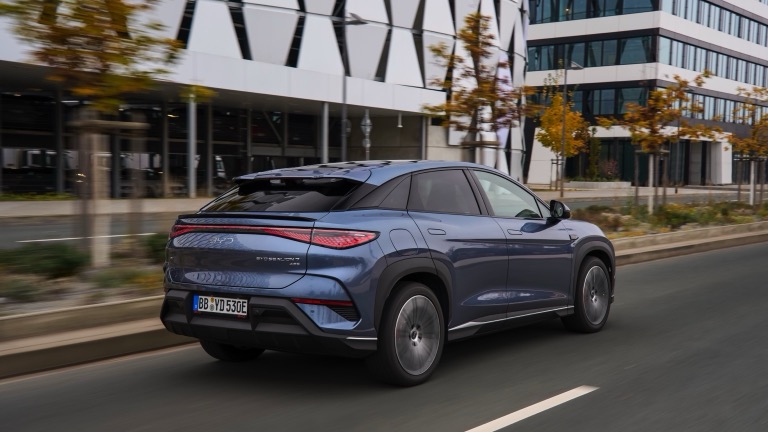
In the fiercely competitive Australian electric vehicle market, a new wave is crashing ashore, driven by Chinese automotive giant BYD. With the release of the 2025 BYD Sealion 7 Performance, the company is directly aiming for the crown currently worn by the dominant champion, the Tesla Model Y. This is not just another rival; it’s a strategically positioned, heavily-specced, and aggressively priced contender that has already proven capable of shaking up the sales charts.
Australians have embraced the Model Y for its blend of performance, technology, and usable space. Now, the Sealion 7 Performance arrives to offer a compelling alternative that brings a fresh perspective to the medium electric SUV segment, and in doing so, delivers plenty of unexpected surprises.
⚡ Raw Power Meets Value: The Performance Equation
The star of the show for performance enthusiasts is the flagship Sealion 7 Performance variant. Underneath its sleek, ocean-inspired exterior lies a potent dual-motor, all-wheel-drive (AWD) setup.
- Outputs: A hefty 390kW of power and 690Nm of torque.
- 0-100 km/h: A blistering claimed time of 4.5 seconds.
This turn of speed is significant. While the Tesla Model Y Performance is quicker, the Sealion 7 Performance is undeniably fast enough to deliver that signature, instant-torque EV thrill, easily putting it into the category of a seriously quick family SUV. It’s an effortless surge that will leave most internal combustion rivals in its dust, proving that BYD is serious about delivering on the ‘Performance’ nameplate.
Crucially, this is delivered at a price point that substantially undercuts the Model Y equivalent, making the raw power incredibly accessible to the Australian consumer. The Sealion 7 Performance, priced from $63,990 plus on-road costs, is squarely aimed at hitting Tesla where it hurts: the hip pocket.
🇦🇺 Tuned for Australia: Drive and Dynamics
One of the pleasant surprises noted by Australian reviewers is the refinement in the Sealion 7’s driving experience compared to earlier BYD models. The vehicle rides on the same e-Platform 3.0 as its Seal sedan sibling, but for the Sealion 7, BYD has dialled in the tuning for a more agreeable ride on our often-challenging local roads.
The Performance model, sitting on sportier 20-inch alloy wheels and Michelin Pilot Sport EV tyres, strikes a commendable balance.
- Ride Comfort: It is generally composed and comfortable on urban streets and at speed, successfully absorbing most road imperfections.
- Handling: The Sealion 7 feels planted and secure, thanks to its low centre of gravity. While it may not possess the same laser-sharp, two-dimensional dynamic fluency of a Model Y, it offers confident, above-average body control on fast, flowing country roads. For the vast majority of Australian family SUV buyers, this balance of comfort and security will be more than satisfactory.
- Braking: The brake-pedal feel is notably progressive and natural, avoiding the “light-switch” inconsistency sometimes found in budget-focused EVs.
However, the handling is not without its quirks. The steering can lack on-centre engagement and feedback, making it feel less ‘driver-focused’ than its rival. Furthermore, the lane-keep assist system has been criticised for being aggressively calibrated, occasionally feeling “snatch-and-grab” in its operation—a software issue BYD will hopefully address via over-the-air updates.
🏠 Interior Upscale: Space, Tech, and Comfort
Stepping inside the Sealion 7 is perhaps the biggest surprise. The interior has matured significantly, moving away from the more ‘organic’ and sometimes cluttered designs of previous BYDs. It presents a cohesive, near-premium aesthetic with a generous use of soft-touch materials and high-quality finishes, including heated and ventilated leatherette front seats.
Key Interior Features:
- Rotating Screen: The headlining feature is the 15.6-inch rotating central touchscreen, which can switch between landscape and portrait orientations, integrating features like wireless Apple CarPlay and wired Android Auto.
- Passenger Space: The 2930mm wheelbase grants acres of room in the rear seat, making it one of the most accommodating SUVs in its class for legroom and comfort—a significant win for growing Australian families.
- Driver Information: Unlike the minimalist Model Y, the Sealion 7 provides a dedicated 10.25-inch digital driver’s display and a useful Head-Up Display (HUD), keeping crucial information directly in the driver’s line of sight.
While the cabin is spacious for passengers, its storage efficiency loses out to the Tesla. The boot offers a decent 500 litres (plus a small 58-litre ‘frunk’), but this falls short of the Model Y’s masterful cargo capacity.
🔋 Battery, Range, and Charging Reality
Both Sealion 7 grades are fitted with an 82.56kWh Blade Battery, which is known for its durability and safety.
| Variant | Drivetrain | Range (WLTP) | Max DC Charge Rate | 0-100 km/h |
| Premium | RWD | 482 km | 150 kW | 6.7 sec |
| Performance | AWD | 456 km | 150 kW | 4.5 sec |
The headline range figures are competitive, particularly the 482km of the RWD Premium, which just edges out the entry-level Model Y’s range. However, the Model Y achieves its comparable range from a significantly smaller battery pack, highlighting a relative lack of energy efficiency in the heavier Sealion 7.
The 150kW maximum DC charging rate is also decent, yet it’s a surprise given BYD’s status as a technology leader. Rivals, including the Model Y (up to 175kW) and the Korean counterparts, offer faster charging peaks, giving them a slight edge on those long Australian road trips. BYD does, however, include Vehicle-to-Load (V2L) functionality as standard, a genuinely useful feature for powering appliances on camping trips or during power outages.
👑 The Tesla-BYD Battle for Supremacy
The most significant surprise from the Sealion 7’s launch is the effect it has had on the Australian sales landscape. Within months of its early 2025 release, the Sealion 7 has, on multiple occasions, outsold the Tesla Model Y to become the best-selling EV in Australia for that month. This is a monumental statement, proving that BYD’s formula of high-spec, high-value, and competitive performance is resonating powerfully with local buyers.
The Sealion 7 isn’t an outright ‘Tesla Killer’ in every technical sense—the Model Y still holds an edge in efficiency, charging network access (Superchargers), and luggage capacity.
However, the BYD delivers a superior overall package for the price:
- Better Value: Undercutting the Model Y on price while offering more standard equipment (HUD, V2L, heated steering wheel/rear seats in Performance).
- Better Warranty: A six-year/150,000km vehicle warranty and eight-year/160,000km battery warranty, surpassing Tesla’s basic coverage.
- More Traditional Cabin: The inclusion of a driver’s display and more physical buttons appeals to buyers transitioning from traditional ICE vehicles.
The 2025 BYD Sealion 7 Performance is a compelling, high-calibre vehicle that offers more than just raw speed. It offers a mature, comfortable, and feature-rich experience that is forcing the entire EV segment to reconsider its value proposition. For the Australian buyer, the real winner is the choice created by this exciting new challenger.
Running Cost Comparison: BYD Sealion 7 Performance vs. Tesla Model Y Performance for Australian Drivers
That’s a great comparison point for prospective EV buyers in Australia!
Based on available data for an average Australian driver, the Tesla Model Y Performance is likely to have lower overall running costs than the BYD Sealion 7 Performance, primarily due to its superior energy efficiency and the lack of mandatory scheduled servicing.1
Here is a breakdown of the key factors for comparing their running costs:
⚡ Energy Consumption (Fuel Cost)
The Tesla Model Y Performance has a notable advantage in energy efficiency, which translates directly to lower charging costs over the life of the vehicle.
| Vehicle | Estimated Efficiency (Real-World Range) | Cost per 100 km (at $0.25/kWh) |
| Tesla Model Y | $\sim$15.5 – 17.0 kWh/100 km | $\sim\$3.88 – \$4.25$ |
| BYD Sealion 7 | $\sim$17.0 – 20.0 kWh/100 km | $\sim\$4.25 – \$5.00$ |
Assumptions for Calculation:
- Average Australian Electricity Price (Residential): I’ll use a conservative, middle-of-the-road estimate of $0.25 per kWh for home charging. This will be lower for those with solar/off-peak rates and higher for public charging.
- Annual Distance Driven: The Australian average is generally between 12,000 km and 15,000 km. I will use 15,000 km for a higher-end annual cost estimate.
Estimated Annual Electricity Cost (15,000 km):
- Tesla Model Y (using 16 kWh/100km): $\frac{15,000 \text{ km}}{100 \text{ km}} \times 16 \text{ kWh} \times \$0.25/\text{kWh} = \mathbf{\$600}$
- BYD Sealion 7 (using 18.5 kWh/100km): $\frac{15,000 \text{ km}}{100 \text{ km}} \times 18.5 \text{ kWh} \times \$0.25/\text{kWh} = \mathbf{\$694}$
Conclusion on Energy: The Tesla Model Y Performance will save you approximately $94 per year on electricity alone, assuming an average mix of charging.
🛠️ Servicing and Maintenance
This is the most significant difference in running costs.
Tesla Model Y Performance
- Servicing: Tesla recommends no scheduled annual maintenance.2 Maintenance is condition-based (e.g., cabin air filter replacement, brake fluid check/change, tyre rotation), meaning your service costs are highly variable and generally very low.
- Estimated Cost: Close to $0 per year for mandatory servicing.
BYD Sealion 7 Performance
- Servicing: BYD requires mandatory scheduled logbook servicing every 12 months or 20,000 km (whichever comes first) to maintain the warranty.
- Capped Price Servicing (Estimated, based on general BYD models): The costs fluctuate, but over the first five years (100,000 km), the average annual cost is estimated to be around $300 – $400 per year. The high-mileage (20,000 km/year) schedule has services ranging from a low of $165 to a high of $635 for major services.
Conclusion on Servicing: The Model Y has a clear and substantial cost advantage due to its non-mandatory, “as-needed” maintenance schedule.
🛡️ Warranty and Coverage
While not a direct running cost, the warranty dictates long-term risk and potential major expense exposure.
| Feature | BYD Sealion 7 | Tesla Model Y Performance |
| Vehicle Warranty | 6 years / 150,000 km (Stronger coverage) | 4 years / 80,000 km |
| Battery Warranty | 8 years / 160,000 km (or 70% retention) | 8 years / 160,000 km (or 70% retention) |
Conclusion on Warranty: BYD offers a significantly better and more comprehensive warranty on the overall vehicle, which provides a stronger guard against unexpected large repairs outside of the battery/drive unit coverage.8
🏆 Total Estimated Annual Running Cost Comparison
| Cost Factor | BYD Sealion 7 Performance (Estimated) | Tesla Model Y Performance (Estimated) |
| Annual Electricity Cost (15,000 km) | $694 | $600 |
| Annual Scheduled Servicing Cost | $350$ (average) | $0 (no mandatory logbook) |
| Estimated Annual Running Cost | $1,044 | $600 |
| Difference | $444 more expensive | $444 cheaper |
In summary, for the average Australian driver covering 15,000 km a year: The Tesla Model Y Performance is projected to be approximately $444 per year cheaper to run, due to its efficiency and, more significantly, its minimal servicing requirements.
About EV Evolution
EV Evolution is the leading online platform dedicated to Australian electric vehicle owners and enthusiasts. We foster a vibrant community, delivering essential EV news and insights, and enhancing user engagement through our innovative, AI-powered chatbot for dynamic discussions. Our mission is to empower Australian electric vehicle owners and enthusiasts by fostering a vibrant, AI-driven online community that connects, informs, and advances the nation’s electric vehicle landscape.
