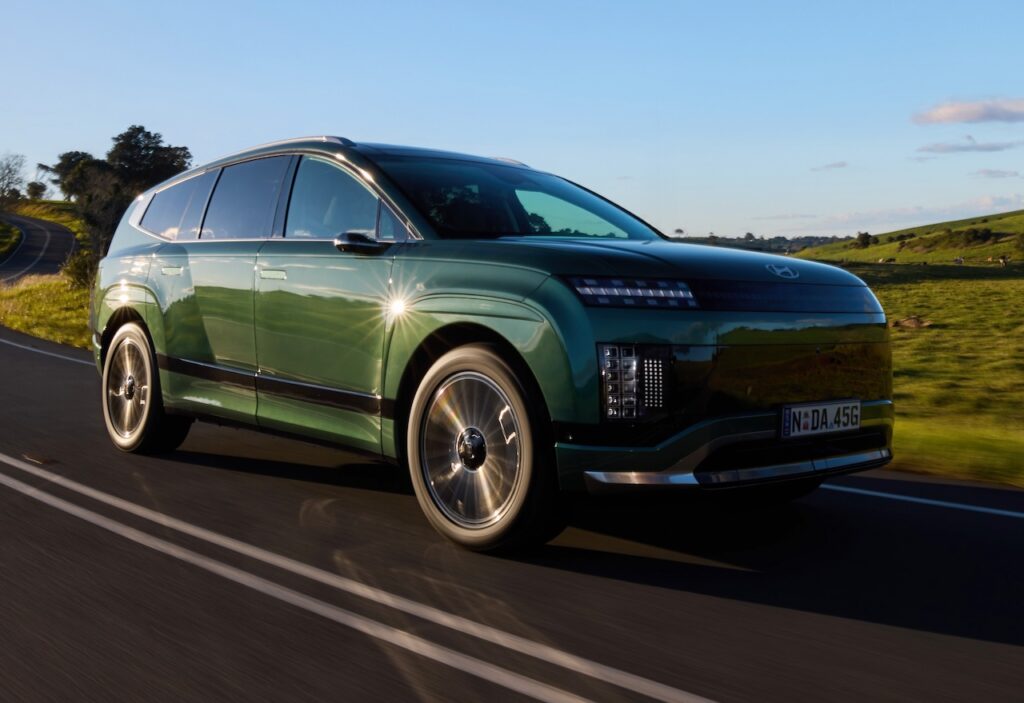



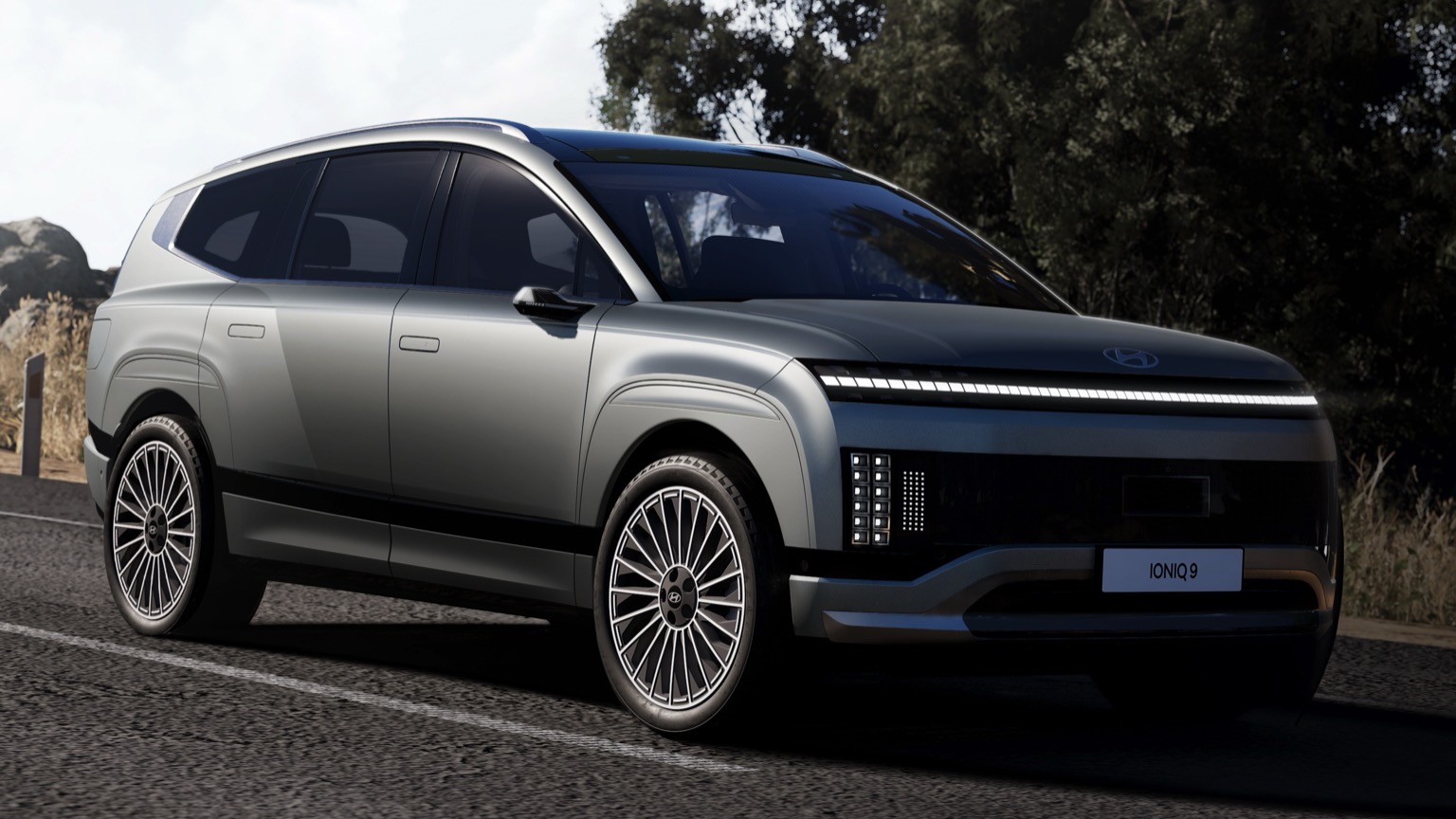
The electric vehicle landscape in Australia is undergoing a dramatic shake-up, and the arrival of the 2025 Hyundai Ioniq 9 is the seismic event we’ve all been waiting for. This isn’t just another big electric SUV; it’s a declaration of war on the established German luxury guard. With a flagship price tag, a colossal battery, and a cabin dripping in high-tech luxury, Hyundai is firmly pointing the Ioniq 9’s sleek nose directly at rivals like the Audi Q8 e-tron and the BMW iX.
For Australian EV buyers who want space, range, and a genuine luxury experience without a four-ring or propeller badge, the Ioniq 9 represents a compelling new frontier. The question is: has Hyundai delivered a true premium competitor, or is the $120,000+ price tag a step too far?
🔋 The Power Play: Specs That Banish Range Anxiety
Hyundai has been savvy with the Ioniq 9’s Australian debut. Recognising the demand for a top-tier family hauler, the company has brought in only the high-spec Calligraphy AWD variant. This strategy immediately positions the Ioniq 9 as a premium player, avoiding the entry-level comparisons that might dilute its luxury pitch.
The key to its impressive pitch is the colossal 110.3 kWh battery pack. This monster energy store translates to a claimed WLTP range of up to 600 km, a figure that should well and truly banish range anxiety for most Aussie families, even those tackling the regional run up the coast or a long trip inland.
| Key Australian Specification (Calligraphy AWD) | Details |
| Price (MLP) | From $119,750 (before on-roads) |
| Drivetrain | Dual-Motor All-Wheel Drive |
| Power/Torque | 314 kW / 700 Nm |
| 0–100 km/h (Claimed) | 5.2 seconds |
| Battery Capacity | 110.3 kWh |
| WLTP Range (Claimed) | Up to 600 km |
| DC Fast Charging (10-80%) | Approx. 24 minutes (on 350kW charger) |
| Seating | 7-seat bench standard (6-seat captain’s chairs optional) |
Crucially, the Ioniq 9 sits on Hyundai Motor Group’s excellent 800V E-GMP platform. This is a game-changer for charging, allowing it to take advantage of Australia’s fastest 350 kW DC ultra-rapid chargers. Pulling up to a charger and seeing the battery leap from 10% to 80% in around 24 minutes is a huge win for long-distance family travel, significantly reducing downtime compared to many 400V rivals.
The dual-motor setup, churning out a punchy 314 kW and 700 Nm, is far from a slouch. Despite its hefty circa-2.7-tonne kerb weight, the Ioniq 9’s 5.2-second sprint to 100 km/h is comfortably in performance SUV territory. Early local reviews praise the car’s immediate, effortless surge of power and its surprisingly agile handling, a testament to the local tuning of the MacPherson strut front and five-link rear suspension, which also features a self-levelling damper system for when the boot is loaded up with kids and cargo.
🛋️ Lounge-Like Luxury: The Interior Game Changer
If the Germans established the benchmark for exterior prestige, the Koreans are now rewriting the rules for interior experience. The Ioniq 9’s cabin is where it truly earns its ‘Audi and BMW hunting’ title.
This is a true three-row family bus, stretching over five metres long and offering generous space in all three rows. The highlight for most reviewers is the optional six-seat configuration ($2,000 extra), which replaces the middle bench with a pair of plush, individual captain’s chairs. These seats, often referred to as ‘premium relaxation’ seats, offer heating, ventilation, and a fold-out leg rest—features typically reserved for true high-end luxury vehicles.
Key interior highlights cementing its premium feel include:
- Panoramic Curved Display: Dual 12.3-inch screens for the instrument cluster and infotainment.
- Premium Materials: Nappa leather upholstery and a suede headliner.
- Cutting-Edge Tech: Digital Key 2.0 (allowing your smartphone to lock, unlock, and start the car), Google Places Search integration, and Over-The-Air (OTA) updates.
- A Sanctuary of Quiet: The cabin features Active Noise Control-Road (ANC-R)—essentially noise-cancelling headphones for the car—working alongside acoustic glass and sound-absorbing tyres to create a truly whisper-quiet ride.
The practicality is also impressive. With all three rows in use, the boot offers 338 litres, enough for a few small bags. Fold the third row down with the easy one-touch power-folding switches, and that space expands significantly to 908 litres, ready for any family adventure.
⚔️ The Competition: Ioniq 9 vs. the Euros and Kia
The Ioniq 9 arrives into an increasingly crowded, but still high-stakes, segment.
Its most direct internal rival is the mechanically similar Kia EV9, which is currently priced from $97,000 to $121,000 for the flagship GT-Line. The Ioniq 9, coming only in the full-spec Calligraphy AWD from $119,750 MLP, is Hyundai’s attempt to step clearly above the Kia and directly challenge the established premium players.
| Feature Comparison (High-Spec Variants) | Hyundai Ioniq 9 | BMW iX xDrive45 | Audi Q8 e-tron 55 |
| Starting Price (MLP) | ~$119,750 | ~$150,000+ | ~$153,900+ |
| Seating | 7 (or 6-seat captain’s chairs) | 5 | 5 |
| Max Range (WLTP) | 600 km | ~600 km (iX xDrive50) | 582 km |
| DC Max Charging Architecture | 800V (Up to 350kW) | 400V (Up to 175kW) | 400V (Up to 170kW) |
The comparison table highlights the Ioniq 9’s bold advantage: it offers three rows of seating and the superior 800V ultra-rapid charging architecture for a significantly lower starting price than its German rivals. The Audi Q8 e-tron and BMW iX are fantastic EVs, but they are strictly five-seaters and use a slower 400V charging system. For a family that needs seven seats and wants the premium EV experience, the choice becomes very clear. The Ioniq 9’s performance and luxury features genuinely challenge the Euros, making its value proposition incredibly strong, despite being the most expensive Hyundai ever sold in Australia.
✅ The Verdict: A Flagship That Earns Its Stripes
The 2025 Hyundai Ioniq 9 is a landmark vehicle for the brand in Australia. It represents a mature, confident Hyundai that is no longer content to play the value card alone.
The Pros:
- Market-Leading Range & Charging: The 600km WLTP range paired with 800V ultra-fast charging is a perfect combination for the Australian market.
- Premium Interior: The cabin comfort, especially the optional six-seat captain’s chairs, is genuinely competitive with luxury marques.
- Space and Practicality: True three-row capability with a decent boot, plus local tuning for Australian roads.
- Exceptional Safety Tech: It has already earned the highest possible “Good” ratings in the new, tougher 2025 IIHS safety standards, offering peace of mind for family buyers.
The Cons:
- Flagship Price: $120k+ is a lot for a Hyundai badge, a psychological hurdle for some.
- No Spare Tyre: The reliance on a tyre mobility kit is a major disappointment for an Australian family SUV intended for long-distance travel.
- Single Variant: Only the top-spec Calligraphy is available, removing a more budget-friendly entry point.
The Bottom Line for Australian EV Buyers:
The Ioniq 9 is more than just a Korean alternative to the Tesla Model X. It is a genuine, high-quality, long-range electric flagship that successfully merges cutting-edge tech with family practicality. It doesn’t just nip at the heels of Audi and BMW; it offers a compelling, better-packaged vehicle for the Australian family that needs seven seats. If you can stomach the badge on the front and the lack of a full-size spare, the Ioniq 9 is not just an EV to consider—it might be the new benchmark for the premium electric family SUV.
Ioniq 9 Ownership Costs Compared: Servicing and Warranty vs. Kia EV9 and BMW iX
Below is a detailed breakdown of the ownership costs for servicing and warranty.
🛡️ Warranty Comparison
Hyundai and Kia, being sister companies, offer segment-leading warranty coverage compared to the premium European offering from BMW.
| Feature | Hyundai IONIQ 9 (Aus. Spec) | Kia EV9 (Aus. Spec) | BMW iX (Aus. Spec) |
| Standard Vehicle Warranty | 5 Years / Unlimited Km (Can be extended to 7 years with dealer servicing from June 2025) | 7 Years / Unlimited Km (Standard) | 5 Years / Unlimited Km |
| High-Voltage Battery Warranty | 8 Years / 160,000 km | 8 Years / 160,000 km | 8 Years / 160,000 km |
Key Takeaway:
- Kia EV9 offers the most generous standard vehicle warranty at 7 years / Unlimited Km.1
- The IONIQ 9 is competitive, with a standard 5-year warranty, but offers a potential 7-year warranty if all scheduled services are completed at an authorised Hyundai dealer (for vehicles first registered from June 1, 2025).
- All three vehicles match on the critical high-voltage battery warranty: 8 years / 160,000 km.2
🛠️ Servicing Cost Comparison (Australia)
Servicing an EV is generally cheaper than a combustion engine vehicle, but the cost structure and intervals vary significantly.3 The South Korean rivals offer transparent, prepaid/capped-price options, while BMW uses a Condition Based Service (CBS) system with a pre-paid plan.
1. Hyundai IONIQ 9 (Capped Price Servicing)
| Interval | Time / Distance (whichever comes first) | Capped Price (Per Service) |
| Service 1 | 24 months / 30,000 km | $660 |
| Service 2 | 48 months / 60,000 km | $685 |
| Total Cost for 4 Years / 60,000 km | $1,345 |
- Service Intervals: A generous 24 months or 30,000 km, which is the least frequent of the three competitors.4
- Total Cost: Extremely competitive, making it the most affordable for the first four years/60,000 km.
2. Kia EV9 (Prepaid EV Service Plans)
Kia offers a prepaid service plan structure for the EV9.5
| Plan Duration | Price |
| 3 Year Plan | $706 |
| 5 Year Plan | $1,351 |
| 7 Year Plan | $1,997 |
- Service Intervals: 12 months or 15,000 km (typical for Kia models).
- Total Cost: Very low, even with the more frequent annual servicing. The 5-year plan cost of $1,351 is highly attractive. The 7-year plan is also outstanding value.
3. BMW iX (Service Inclusive Basic Plan)
BMW uses a Condition Based Service (CBS) system, but the Service Inclusive Basic package covers your scheduled servicing needs for a set price.6
| Plan Duration | RRP Price (iX) |
| 6 Years / Unlimited Km | $3,475 |
- Service Intervals: Determined by the car’s Condition Based Service (CBS) monitoring system, not a fixed interval.
- Total Cost: The $3,475 up-front cost is for a substantial 6 years of coverage, regardless of kilometres.7 While higher than the Kia and Hyundai’s initial 4-5 year plans, it covers an extra year (or more depending on the Kia plan chosen) and is a significant saving compared to servicing a luxury SUV out of pocket.
- Note: Wear-and-tear items (like brake pads and discs) are not included in the Basic plan and would require the pricier ‘Service Inclusive Plus’ package.
🥇 Comparative Summary
| Feature | Hyundai IONIQ 9 | Kia EV9 | BMW iX |
| Vehicle Warranty | Good (5yr / unltd, up to 7yr conditional) | Best (7yr / Unlimited Km) | Standard (5yr / unltd) |
| Battery Warranty | Excellent (8yr / 160,000km) | Excellent (8yr / 160,000km) | Excellent (8yr / 160,000km) |
| Service Frequency | Best (24 months / 30,000 km) | Standard (12 months / 15,000 km) | Flexible (Condition Based Service) |
| 4-Year Servicing Cost (Approx.) | Lowest ($1,345 for 4yr/60k) | Low ($1,351 for 5yr plan) | Medium-High (Part of $3,475 for 6yr/unltd) |
Conclusion on Ownership Costs:
- Kia EV9 (Overall Winner on Value): The combination of a 7-year unlimited kilometre warranty and the most competitive prepaid service plans makes the EV9 the clear leader for long-term ownership peace of mind and lowest guaranteed cost.8
- Hyundai IONIQ 9 (Best on Intervals): The 24-month/30,000km service interval is a huge convenience factor, meaning fewer trips to the dealer.9 Its total servicing cost for the first few services is the lowest outright.
- BMW iX (Luxury Competitor): The iX’s 6-year unlimited km service plan for a fixed fee is very strong for a premium brand, insulating the owner from unexpected luxury service costs.10 However, its initial outlay is higher, and the base vehicle warranty is shorter than the Kia.
About EV Evolution
EV Evolution is the leading online platform dedicated to Australian electric vehicle owners and enthusiasts. We foster a vibrant community, delivering essential EV news and insights, and enhancing user engagement through our innovative, AI-powered chatbot for dynamic discussions. Our mission is to empower Australian electric vehicle owners and enthusiasts by fostering a vibrant, AI-driven online community that connects, informs, and advances the nation’s electric vehicle landscape.