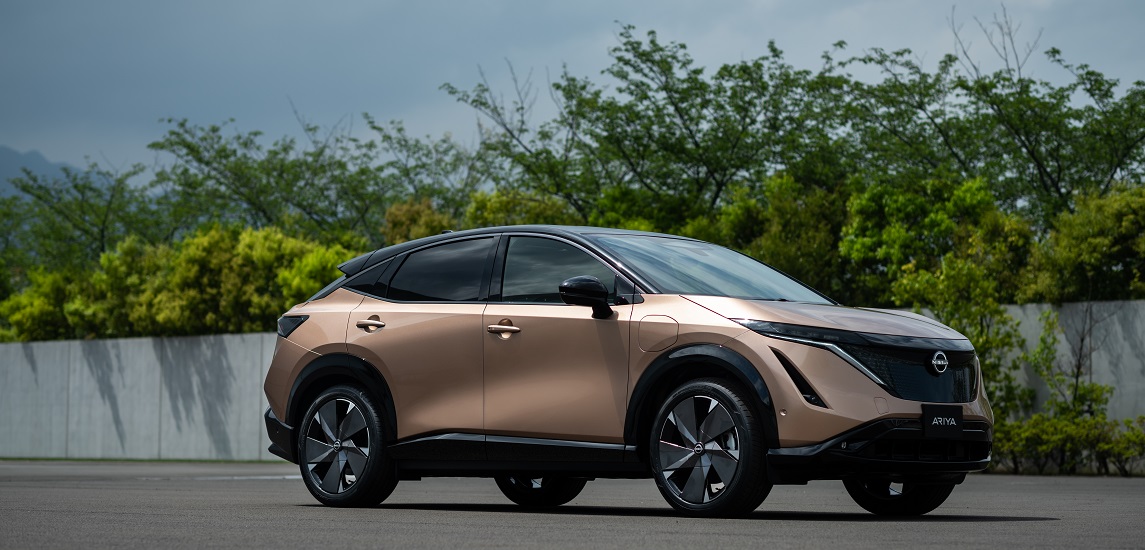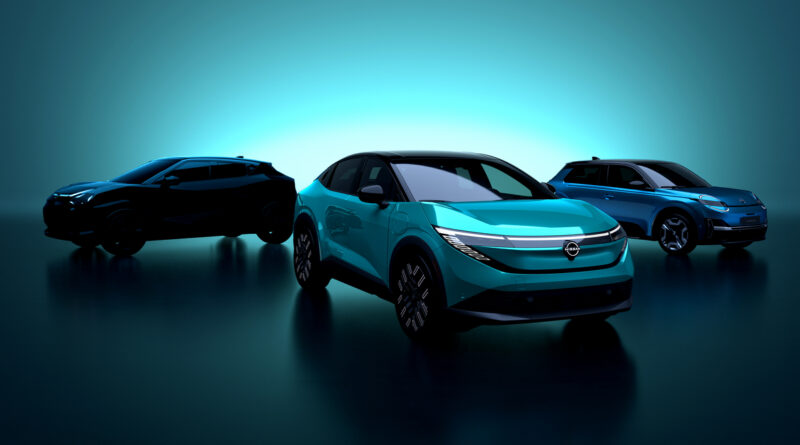



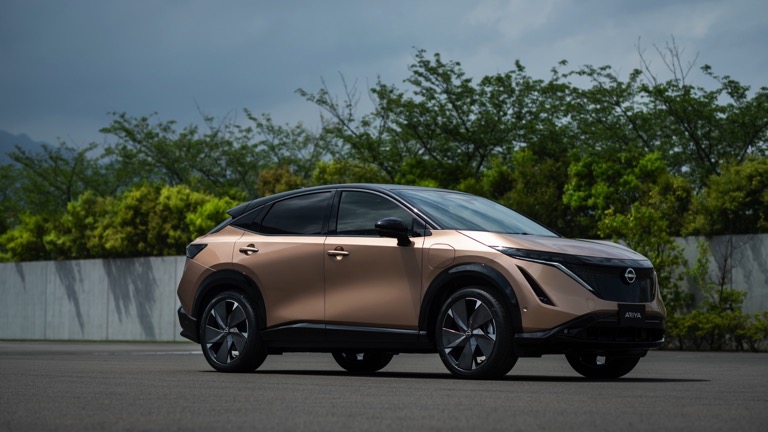
After a long wait that felt like an eternity in the fast-moving electric vehicle world, the Nissan Ariya has finally landed on Australian shores in 2025. For the Japanese marque that pioneered the mainstream EV with the Leaf a decade ago, this moment is pivotal. The sleek, stylish Ariya isn’t just a new model; it’s Nissan’s modern electric flagship, a critical weapon deployed to contest the hotly fought mid-size electric SUV segment against established giants like the Tesla Model Y, strong South Korean contenders like the Kia EV6 and Kia EV5, and the value-driven Chinese assault from BYD (Sealion 7 and Atto 3) and MG (MG4 and ZS EV).
The question for Australian buyers is: Is this latecomer, with its promise of premium Japanese flair and advanced technology, a genuine contender or a missed opportunity?
🇯🇵 Design and Interior: Timeless Japanese Futurism
The Ariya’s design is arguably its strongest hand. Nissan calls the aesthetic “Timeless Japanese Futurism,” and it delivers. Unlike some rivals that lean into aggressive styling or a hyper-minimalist, function-over-form approach, the Ariya presents a beautifully composed, coupe-like profile. Its clean, flowing lines, illuminated Nissan badge, and a smooth, shield-like ‘grille’ (featuring traditional Japanese Kumiko patterns) give it a sophisticated, upmarket presence that truly sets it apart from the crowd.
Inside, the cabin is where the Ariya truly shines as a serene, lounge-like space.
- Premium Vibe: Materials feel genuinely high-quality, with highlights like soft-touch surfaces, subtle copper accents, and, in the top-spec Evolve, stunning Blue Nappa leather and Ultrasuede inserts. The aesthetic is warm and inviting, a welcome contrast to the clinical feel of some competitors.
- Intelligent Features: The dual 12.3-inch displays are elegantly housed in a single, curved panel. The use of haptic touch controls for climate functions, seamlessly integrated into a woodgrain-inspired dash panel, looks exceptionally slick—illuminating only when the car is powered on. A key highlight is the power-sliding centre console on higher grades, which can be moved to customise legroom and storage, reinforcing the ‘lounge’ concept.
- Space and Practicality: The dedicated EV platform ensures a flat floor, enhancing passenger comfort. While rear knee-room is generous, headroom can be tighter for taller occupants (over 190cm) due to the sloping roofline. Boot space is competitive but not class-leading, offering 466 litres in 2WD models and slightly less (408 litres) in the AWD Evolve due to the extra e-4ORCE hardware.
🔋 Performance and Range: A Focus on Comfort over Sprint Speed
The Ariya offers Australian consumers four distinct grades with two battery sizes and a choice of front- or all-wheel drive. The range starts keenly, undercutting the Tesla Model Y, which is a key market advantage.
| Variant (Price + ORCs) | Battery Size | Drivetrain | Power/Torque | WLTP Range | 0–100km/h | AC Charge | DC Charge |
| Engage ($55,840) | 63kWh | FWD | 160kW/300Nm | 385km | 8.0s | 7.4kW | 130kW |
| Advance ($59,840) | 63kWh | FWD | 160kW/300Nm | 385km | 8.0s | 7.4kW | 130kW |
| Advance+ ($63,840) | 87kWh | FWD | 178kW/300Nm | 504km | 8.1s | 7.4kW (22kW optional) | 130kW |
| Evolve e-4ORCE ($71,840) | 87kWh | AWD | 290kW/600Nm | 487km | 5.6s | 22kW | 130kW |
On the road, the Ariya’s driving experience is deliberately calibrated for calm and serenity. The suspension tuning is comfort-focused, making it an excellent urban and highway cruiser, though some reviewers note a slightly firm or “busy” ride on the larger 20-inch wheels of the Evolve.
Performance is adequate in the single-motor variants—perfectly fine for daily driving but lacking the head-snapping acceleration many have come to associate with EVs. The dual-motor, all-wheel-drive Evolve e-4ORCE is the performance hero, offering a brisk 5.6-second dash to 100km/h. Critically, the e-4ORCE system goes beyond just speed, continuously managing torque and braking at all four wheels for enhanced stability and a smoother, more composed ride in all conditions.
However, a genuine concern for Australian buyers is the DC charging rate, which maxes out at 130kW. While this is an improvement on the old Leaf, it falls short of rivals like the Kia EV6 (which boasts an ultra-fast 350kW capability) and even the Tesla Model Y. A 10-80% charge in a decent 35 minutes is acceptable, but it’s not segment-leading for long-distance highway travel. The optional or standard 22kW AC onboard charger on higher grades is a boon for those with access to three-phase charging at home or at public AC stations.
⚔️ The Australian Battleground: Ariya vs. The Competition
The Ariya enters an Australian market that is currently one of the most competitive in the world for electric SUVs. Nissan’s greatest challenge is its arrival time—a car that was designed years ago is now battling a fresh wave of rivals.
- vs. Tesla Model Y: The Ariya counters the segment leader’s brutalist simplicity with premium interior design and Japanese craftmanship. While the Model Y still wins on raw performance, range (in its Long Range variant), and the strength of the Supercharger network, the Ariya offers a more refined, comfortable, and tactile experience. Crucially, the Ariya’s entry price is highly competitive, especially against the Model Y.
- vs. BYD and MG: The Chinese brands, particularly BYD with its new Sealion 7 and value-focused Atto 3, and the MG4, challenge the Ariya on outright value for money. They often offer longer range or more power for a lower price. Nissan relies on its established brand reputation, higher build quality, and superior cabin ambience to justify its pricing premium. The generous 10-year/300,000km warranty (when serviced at Nissan) and 8-year/160,000km battery warranty also offer significant peace of mind.
- vs. Kia and Hyundai: Rivals like the Kia EV6 and Hyundai Ioniq 5 hold a significant technical edge, particularly with their 800-volt architectures enabling ultra-fast DC charging. The Ariya is a more direct, pragmatic competitor to the upcoming Kia EV5—a comfort-focused SUV from a well-established brand. While the Ariya’s 504km range is strong in the Advance+ variant, it’s the charging speed that limits its long-haul credentials against these Korean siblings.
✅ Verdict: A Refined Contender, Not a Game-Changer
The 2025 Nissan Ariya is a deeply considered, beautifully styled, and high-quality electric SUV. It successfully channels a sense of Japanese serenity and premium calm, offering a compelling alternative for Australian buyers who are put off by the stark minimalism or aggressive performance focus of some rivals. The generous standard features, the superb e-4ORCE all-wheel-drive system on the Evolve, and the commendable 504km range of the Advance+ model are clear highlights.
However, its delayed arrival means it faces a market saturated with excellent, rapidly evolving competition. The modest 130kW DC charging speed is its most significant technical drawback in a country where long-distance driving is common.
In summary, the Nissan Ariya doesn’t move the electric vehicle goalposts, but it absolutely brings the Japanese brand back into the EV conversation with a sophisticated and genuinely premium offering. For the buyer prioritising a quiet, luxurious cabin and a composed, comfortable drive over breakneck acceleration and ultra-rapid charging times, the Ariya is a highly worthy and distinctive new option in the Australian EV artillery.
Comprehensive Specification Comparison: Nissan Ariya vs. Tesla Model Y vs. BYD Atto 3 in Australia
Below is a detailed comparison of the key specifications for the entry-level Nissan Ariya against the corresponding variants of the Tesla Model Y and BYD Atto 3.
| Feature | Nissan Ariya Engage | Tesla Model Y Rear-Wheel Drive | BYD Atto 3 Premium (Extended Range) |
| Indicative Starting Price (Excl. On-Road Costs) | A$55,840 | A$58,900 | A$44,990 |
| Body Style | Medium SUV | Medium SUV | Small/Medium SUV |
| Drivetrain | Front-Wheel Drive (FWD) | Rear-Wheel Drive (RWD) | Front-Wheel Drive (FWD) |
| Usable Battery Capacity | $\text{63 kWh}$ | $\text{60 kWh}$ (Usable LFP) | $\text{60.5 kWh}$ (Usable Blade) |
| WLTP Driving Range | $\text{385 km}$ | $\text{466 km}$ | $\text{420 km}$ |
| Power/Torque | $\text{160 kW / 300 Nm}$ | $\text{220 kW / 450 Nm}$ (Approx.) | $\text{150 kW / 310 Nm}$ |
| 0-100 km/h (Claimed) | N/A (Estimated $\sim 7.5 \text{s}$) | $\text{5.9 s}$ | $\text{7.3 s}$ |
| DC Fast Charging Peak | $\text{130 kW}$ (CCS2) | $\text{170 kW}$ (CCS2/Supercharger) | $\text{88 kW}$ (CCS2) |
| AC Charging Max | $\text{7.2 kW}$ | $\text{11 kW}$ | $\text{7 kW}$ |
| Boot Space (VDA) | $\text{468 L}$ (Rear seats up) | $\text{854 L}$ (Rear seats up) + $\text{117 L}$ Frunk | $\text{440 L}$ (Rear seats up) |
| Max Braked Towing | $\text{750 kg}$ | $\text{1600 kg}$ | $\text{750 kg}$ |
| Infotainment Screen | $\text{12.3-inch}$ Touchscreen | $\text{15.4-inch}$ Central Touchscreen | $\text{15.6-inch}$ Rotating Touchscreen |
| Apple CarPlay / Android Auto | Wireless (Standard) | No (Integrated System Only) | Wireless (Standard) |
| Warranty (Vehicle) | $\text{5 years / Unlimited km}$ (Conditional $\text{10 year}$ cover offered) | $\text{4 years / 80,000 km}$ | $\text{6 years / 150,000 km}$ |
| Battery Warranty | $\text{8 years / 160,000 km}$ ($\text{70\%}$ minimum capacity) | $\text{8 years / 160,000 km}$ ($\text{70\%}$ minimum capacity) | $\text{8 years / 160,000 km}$ ($\text{70\%}$ minimum capacity) |
Key Takeaways from the Comparison
- Price: The BYD Atto 3 is the clear value leader, undercutting both rivals significantly. The Nissan Ariya slots in between the BYD and the Tesla, providing a more premium starting price than the Atto 3.
- Performance & Efficiency: The Tesla Model Y dominates in terms of outright power, torque, and acceleration, offering the quickest drive. It also boasts the best WLTP range, leveraging its excellent efficiency.
- Charging: The Tesla Model Y has the highest DC fast charging peak and the fastest AC charging rate. The Nissan Ariya‘s DC charging peak is solid, while the BYD Atto 3‘s is the lowest of the three, but still adequate for most users.
- Practicality: The Tesla Model Y offers a massive advantage in cargo space, featuring both a large boot and a front trunk (frunk). It also has a significantly higher braked towing capacity. The BYD Atto 3 has a competitive main boot size for its class.
- Technology & Warranty: The BYD Atto 3 and Nissan Ariya include both Apple CarPlay and Android Auto, which the Tesla omits in favour of its own integrated system. The BYD offers the best standard vehicle warranty (6 years/150,000km).
About EV Evolution
EV Evolution is the leading online platform dedicated to Australian electric vehicle owners and enthusiasts. We foster a vibrant community, delivering essential EV news and insights, and enhancing user engagement through our innovative, AI-powered chatbot for dynamic discussions. Our mission is to empower Australian electric vehicle owners and enthusiasts by fostering a vibrant, AI-driven online community that connects, informs, and advances the nation’s electric vehicle landscape.