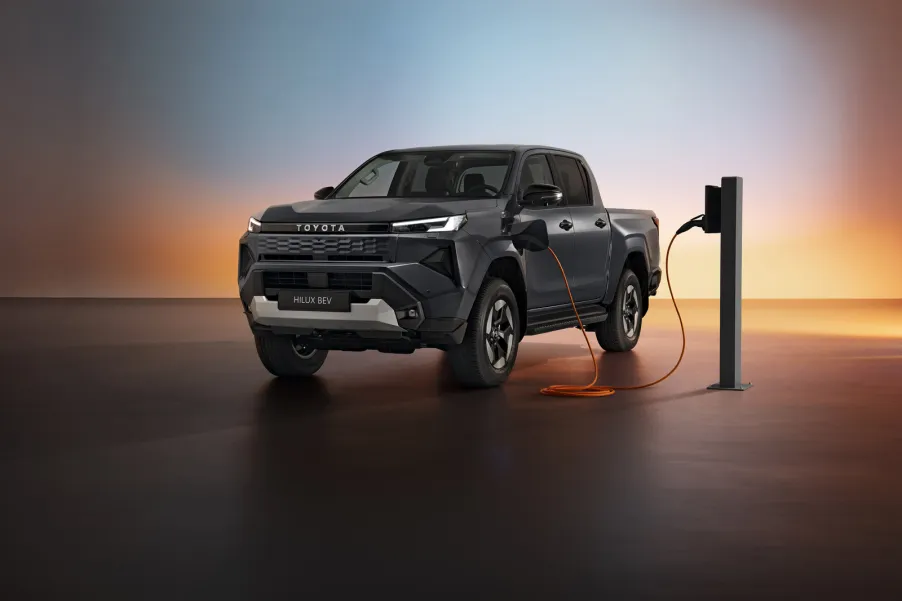


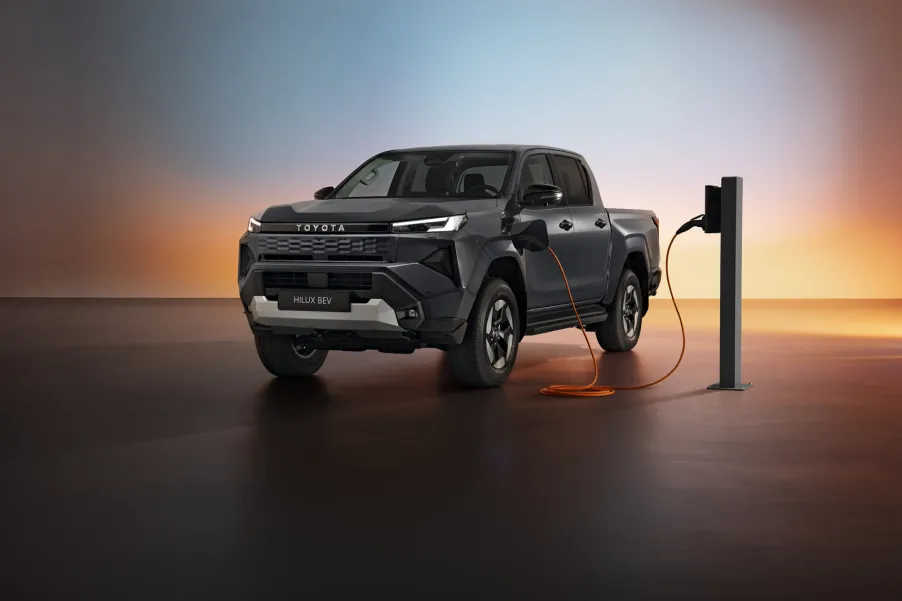
It’s a classic Tuesday morning on a Western Sydney job site. The sun is already pushing 38°C, the dust is thick enough to chew, and the sound of idling turbo-diesels is the backtrack to the daily grind. But as we roll into 2026, a new sound—or lack thereof—is entering the fray. We’ve put the silent Toyota HiLux EV against its “Unbreakable” 2.8L Turbo Diesel brother. Can the battery-powered king actually handle a tray full of tools in a 40-degree Aussie heatwave, or is the old-school oil-burner still the only way to get the job done?
At EV Evolution, we don’t do fluff. We know that for most Aussies, a ute isn’t a lifestyle accessory; it’s a toolbox on wheels. If it can’t tow, if it can’t haul, and if it can’t survive a “cooked” day in the Pilbara or the Hunter Valley, it doesn’t belong on the leaderboard.
Today, we’re breaking down the specs, the “real-world” range, and the brutal truth about the 2026 HiLux Duel.
The Challenger: 2026 Toyota HiLux EV (The “Silent Sumo”)
Let’s be real: when Toyota announced an electric HiLux, half of Australia cheered and the other half laughed. But the Toyota HiLux BEV isn’t a city-hatch in a costume. It’s built on the same rugged ladder-frame chassis as the SR5, but with a high-voltage heart.
- The Performance: It’s packing dual electric motors (one on each axle) that deliver instant torque. While the power figures are still being whispered in the hallways of Toyota’s Altona HQ, the seat-of-the-pants feel is undeniable. It’s faster off the mark than the diesel, and it does it without the vibration and noise.
- The Battery: A 59.2kWh Lithium-Ion pack tucked safely inside the frame rails.
- The Strategy: Toyota is being honest here—the HiLux EV range of approximately 240km (WLTP) is squarely aimed at “back-to-base” fleets, mining sites, and urban tradies.
- The Price: Expected to land between $90,000 and $100,000, making it a premium tool for a specific job.
The Defender: Toyota HiLux 2.8L Turbo Diesel (The “Unbreakable” Icon)
The 2026 update to the 2.8L 1GD-FTV engine hasn’t reinvented the wheel, but it has refined it. With 150kW and 500Nm (in the auto), it remains the benchmark for reliability.
- The Range: An 80L tank means you’re looking at over 1,000km of highway cruising.
- The Refinement: The 2026 model now features V-Active 48V technology (mild hybrid) as standard on SR5 and Rogue grades, making the stop-start system smoother than a flat white on a Saturday morning.
- The Price: Starting from $33,990 for the WorkMate single cab, up to $71,990 for the Rogue.
The Towing Duel: 3.5 Tonnes vs. 1.6 Tonnes
This is where the “vibe” gets serious. For many tradies, the deal-breaker is the electric HiLux towing capacity.
| Spec | HiLux EV (BEV) | HiLux 2.8L Diesel |
| Braked Towing | 1,600kg (Approx) | 3,500kg |
| Payload | 715kg | ~1,000kg |
| Wading Depth | 700mm | 700mm |
The Reality Check: If you’re towing a 3-tonne excavator or a triple-axle caravan across the Nullarbor, the HiLux EV isn’t your car. Not yet. Toyota has kept the battery small (59.2kWh) to preserve payload, but that limits the towing grunt. For the plumber with a tray of pipes or the council worker with a light trailer, the 1.6t capacity of the EV is plenty. But for the heavy-duty hauler? Diesel is still the king of the best work utes in Australia for 2026.
Heat vs. Humidity: Survival on the Job Site
We’ve all been there—40 degrees in the shade, and you’ve got the AC on “Arctic” just to keep your sanity.
In the Diesel: You’re burning fuel to stay cool. The engine fan is roaring, and the cooling system is working overtime. It’s a proven system that won’t let you down, but it’s expensive and noisy.
In the EV: This is the “Stealth Flex.” You can sit on a site with the AC at 18°C for hours, and it barely makes a dent in the battery. Why? Because an electric compressor is incredibly efficient compared to a belt-driven one. However, the EV Evolution team found that in extreme 40-degree heat, the EV’s range can drop by up to 15% as the Battery Management System (BMS) works to chill the cells.
Pro Tip: Don’t let the summer heat catch you out. Ask the EV Evolution AI to compare the towing range of the HiLux EV vs. the Shark 6. Our AI has the data on how different battery chemistries handle an Aussie scorcher.
The Brand Voice: Why the Evolution Matters
At EV Evolution, we aren’t here to tell you to ditch your diesel today. We’re here to help you plan for the inevitable. The electric HiLux represents the first “Unbreakable” step into a silent future. It’s perfect for the “Depot-to-Site” life where you charge while you sleep and save $100 a week in fuel.
But we also know that Australia is big, hot, and unforgiving. That’s why we created the EV Strategy Suite.
Settle the Math with the Suite
Before you decide between the silent torque of the EV and the long-range safety net of the Diesel, use our tools:
- EV Tax Savings Estimator: The EV qualifies for the 0% FBT exemption until the 2026/27 review. That could save your business $5,000+ a year. The Diesel? You’re paying full freight.
- Vibe Check Tool: Does your work route have the DC fast-chargers to support a mid-day top-up? If you’re in a “Charging Desert,” the Diesel is still the safe bet.
Join the Conversation
The “Ute-Off” of 2026 is just the beginning. With Ford’s Ranger PHEV and BYD’s Shark 6 already carving up the market, the choice has never been harder.
Don’t get left behind with “Old Mate’s” outdated advice. Keep coming back to EV Evolution for the latest search trends, news updates, and real-world testing.
Got a specific question about the HiLux EV’s tray dimensions or how it handles a flooded creek? Start a 24/7 conversation with our AI Agent. It’s like having a professional automotive journalist in your pocket, ready to settle the debate.
The future of the Aussie worksite is here. Is it silent, or is it smoking? That’s up to you.
Tradie’s Charging Blueprint
For a tradie, time is literally money. If you aren’t on the tools, you aren’t earning. The biggest myth circling the job site in 2026 is that switching to an EV like the Toyota HiLux BEV or the LDV eT60 means sitting around for hours waiting for a battery to “fill up.”
That is total friction. If you’re smart, you can run an electric ute for an entire year without losing a single billable hour to charging. Here is the EV Evolution Tradie’s Charging Blueprint.
Phase 1: The “Invisible” Home Charge (0 Minutes Lost)
In 2026, the foundation of every electric trade business is the 7.2kW Home Wallbox. Think of it like your cordless tool charger—you don’t watch it blink; you plug it in at knock-off and forget about it.
- The Routine: Plug in at 6:00 PM. By 6:00 AM, you’ve added roughly 350km of range while you were sleeping.
- The Cost: If you have rooftop solar or a 2026 “Off-Peak” plan, your cost per kilometre is nearly $0.
- The Efficiency: $$\text{Daily commute (80km)} + \text{On-site driving (40km)} = 120\text{km total.}$$This uses only about 25% of a modern 1-tonne ute’s battery. You start every single day with a “full tank” without ever visiting a petrol station.
Phase 2: The “Lunch-and-Liters” Hack (0 Minutes Lost)
Need a top-up for a big afternoon? In 2026, the 400kW Ultra-Fast Network is integrated into exactly where you already spend your lunch break.
- The Strategy: Check the EV Vibe Tool for an Ampol, BP Pulse, or Evie station near your local bakery or Bunnings.
- The Speed: A 400kW charger can add 200km of range in 12 minutes.
- The Integration: By the time you’ve grabbed a meat pie and checked your emails, your car is ready for the next three jobs. You didn’t “wait” for the car; the car waited for you to finish lunch.
Phase 3: Hardware Store “Opportunity Charging”
Hardware giants like Bunnings have rolled out massive AC charging banks in 2026.
- The Move: Whenever you’re doing a mid-day materials run, plug into a 22kW AC destination charger.
- The Gain: A 30-minute shop adds roughly 40km of range—effectively “erasing” the trip you just took to get there. It’s free or low-cost energy that keeps your battery in the “Green Zone” all day.
The “Site Generator” Flex: V2L for Tools
The ultimate tradie hack in 2026 isn’t just about charging the car; it’s about the car charging you. With Vehicle-to-Load (V2L) technology, your ute is a mobile 3.6kW power station.
- No Petrol Generators: Plug your drop saws, chargers, and compressors directly into the tray.
- Silent Power: Work in residential areas at 7:00 AM without noise complaints.
- The Efficiency: Running power tools all day typically uses less than 2-3% of the vehicle’s total battery.
🚀 Stop Guessing. Start Scaling.
Don’t let “Old Mate” tell you it can’t be done. The infrastructure in 2026 is ready for the tools.
Ask the EV Evolution AI Agent for a “Work-Day Audit.” Paste in your daily route and tool requirements, and it will tell you exactly where your nearest “Lunch-and-Liters” stop is and how much you’ll save on fuel this month.
About EV Evolution
EV Evolution is Australia’s authoritative strategic platform for electric vehicle market, dedicated to providing a high-fidelity knowledge base for the next generation of drivers. In a year defined by the Federal statutory review of FBT exemptions and the rapid arrival of record-breaking affordable models, we serve as your professional co-pilot to ensure every automotive decision is data-driven and future-proof. Our EV Strategy Suite—including the EV Tax Savings Estimator, Vibe Check Tool, and 24/7 AI Strategy Agent—empowers young professionals and families to navigate complex technical and regulatory shifts with total transparency. At EV Evolution, we don’t just track the market, we provide the strategic roadmap for your transition to the new electric standard.