



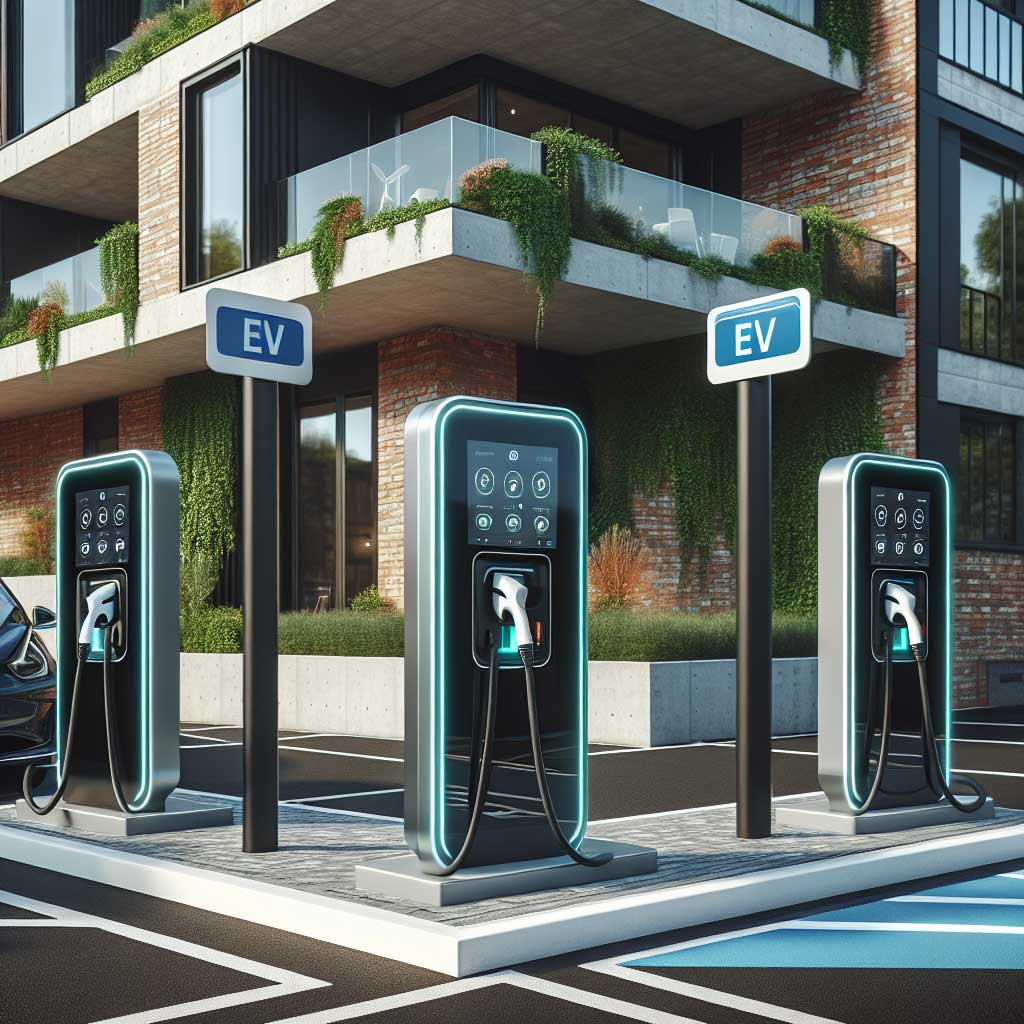
It’s February 2026, and if you’re one of the millions of Australians living in a sleek urban apartment or a classic red-brick walk-up, you’ve likely felt a bit of “charging envy.” You see the detached-house dwellers plugging in their Tesla Model 3s or BYD Sealion 7s every night with ease, while you’re left eyeing the communal power point in the basement like it’s a forbidden treasure.
For a long time, the advice for apartment dwellers was “wait and see.” Well, at EV evolution, we’re here to tell you: the wait is over.
The 2026 landscape for apartment EV charging in Australia has undergone a massive transformation. Between legislative “Right to Charge” reforms and sophisticated Load Management Systems, the dream of waking up to a full battery in your basement parking spot is finally a reality. Here is your professional guide to navigating the strata maze and getting your building EV-ready.
🏗️ The 2026 Legal Landscape: No More “Automatic No”
One of the biggest hurdles in the past was the “Special Resolution”—the dreaded 75% vote. In many older strata schemes, a handful of skeptical owners could block an EV project indefinitely.
In 2026, the game has changed. Most Australian states have followed the lead of the Strata Schemes Management Amendment (Sustainability Infrastructure) Act. In NSW, for example, EV infrastructure is now classified as “Sustainability Infrastructure.”
- The Voting Shift: Instead of a 75% super-majority, these motions now only require a simple majority (over 50%). If more people want it than don’t, it passes.
- The Right to Charge: In 2026, the conversation has moved toward a “Right to Charge” model. While you still need approval, committees are finding it legally much harder to say “no” without a valid technical reason (like the building literally running out of power).
Before you approach your committee, it’s worth arming yourself with the financial facts. Use our EV fuel savings calculator to show them that an EV-ready building isn’t just about “green vibes”—it’s about protecting the property’s resale value as petrol cars become the “blockbuster videos” of the 2020s.
🛠️ Three Ways to Charge: Choosing Your Building’s Path
When it comes to Strata EV charger installation, there isn’t a one-size-fits-all solution. In 2026, buildings generally choose one of three paths:
1. The “Backbone” Model (Whole-of-Building)
This is the “Gold Standard” for 2026. The Owners Corporation installs a communal “busway” or cable tray through the basement. Individual owners then pay to tap into this backbone when they are ready to buy an EV.
- Pros: Scalable, neat, and avoids the “first-come, first-served” capacity trap.
- Cons: Higher upfront cost for the strata scheme.
2. The Shared Model (Visitor Spot)
The building installs 2–4 “shared” chargers in visitor spots. Residents use an app (like Chargefox or Evie) to book a slot and pay for their usage.
- Pros: Low initial cost; great for smaller buildings.
- Cons: Can lead to “charger rage” if the building has more than a few EV owners. You can use The EV Vibe Check to see how other local apartment dwellers rate their shared charging experiences.
3. The Smart Socket (Low-Cost Retrofit)
A 2026 trend we’re seeing is the rollout of Level 1 Intelligent Power Sockets (IPS). These are smart 10-amp or 15-amp points. While slower than a wallbox, they are incredibly cheap to install in older basements that lack the juice for 20 fast chargers. Check our EV charging time calculator to see if a slower overnight “sip” is enough for your daily commute.
🧠 The Unsung Hero: Load Management Systems (LMS)
If you take one thing away from this guide, let it be this: Load Management is the secret to strata success.
Most Aussie apartment basements were wired for lights and the occasional garage door, not for 50 cars drawing 7kW each. An LMS is a “brain” that monitors the building’s total power use. When people are cooking dinner and running elevators, it slows down the car chargers. When the building “sleeps” at 2 AM, it ramps the chargers up.
Without an LMS, your building might need a $200,000 transformer upgrade. With an LMS, you can often fit 20+ chargers on the existing supply. It’s the difference between a project that gets approved and one that gets binned.
💰 The Math: Billing and Grants
“Who pays for the power?” is the most common question at any AGM. In 2026, “User Pays” is the only way to go.
- Billing Platforms: Systems like Jet Charge or Exploren integrate directly with the charger. The resident is billed per kWh, and the money is reimbursed to the strata’s electricity account. Use our EV charge cost tool to estimate what your monthly strata “fuel bill” will look like.
- Grants: While the massive 2024 NSW grants have mostly closed, new 2026 co-funding rounds for “EV-Ready Feasibility” are still popping up. Check with your local council or state energy office for 2026 infrastructure subsidies.
📋 Your 5-Step Pitch to the Strata Committee
Ready to lead the EV evolution in your building? Here is your tactical plan:
- Survey the Residents: Find out how many people have an EV, have ordered one (like the new Mazda 6e), or plan to buy one in the next two years.
- Request a Feasibility Study: Don’t guess your capacity. Ask the committee to spend ~$2,000 on a professional energy audit to see what the building can actually handle.
- Propose a “User-Pays” By-Law: Reassure the non-EV owners that they won’t be subsidising your “fuel.” A clear by-law protects everyone.
- Highlight Value: Remind the committee that in 2026, a “No EV” building is a “No Buy” building for a huge chunk of the market.
- Call in the Experts: Bring in a specialized strata installer (like EVSE or Schneider) to present a professional proposal.
🤖 Still Facing a “Stone Wall” from Your Committee? Ask the AI
Every building is different. Maybe you have a complex car stacker system, or your basement is a “heritage listed” concrete fortress. How do you handle charging in a stacker? What if your parking spot is 100 metres from the switchboard?
Don’t leave it to chance—start a conversation with the EV evolution AI Agent. Our AI is the ultimate strata advocate. It’s updated with the latest 2026 state regulations, technical solutions for car stackers, and “success stories” from across Australia. You can ask:
- “How do I draft a formal request for EV charging to my NSW strata committee?”
- “What is the best load-managed charging solution for a 40-unit building in Victoria?”
- “Can a BYD Sealion 7 charge safely on a 10-amp smart socket in a basement?”
- “Explain the ‘Right to Charge’ laws currently being debated in 2026.”
The Verdict: Don’t Let the Basement Stop You
In 2026, apartment EV charging in Australia is no longer a luxury—it’s a utility. With the right strategy, the right tech, and a bit of help from EV evolution, you can turn your apartment parking spot into the high-tech charging hub you deserve.
Ready to start the conversation with your building? Head over to our EV fuel savings calculator to gather your “value” data, or chat with our AI Agent to get a custom roadmap for your strata today.
About EV Evolution
EV Evolution is Australia’s authoritative strategic platform for electric vehicle market, dedicated to providing a high-fidelity knowledge base for the next generation of drivers. In a year defined by the Federal statutory review of FBT exemptions and the rapid arrival of record-breaking affordable models, we serve as your professional co-pilot to ensure every automotive decision is data-driven and future-proof. Our EV Strategy Suite—including the EV Tax Savings Estimator, Vibe Check Tool, and 24/7 AI Strategy Agent—empowers young professionals and families to navigate complex technical and regulatory shifts with total transparency. At EV Evolution, we don’t just track the market, we provide the strategic roadmap for your transition to the new electric standard.
