


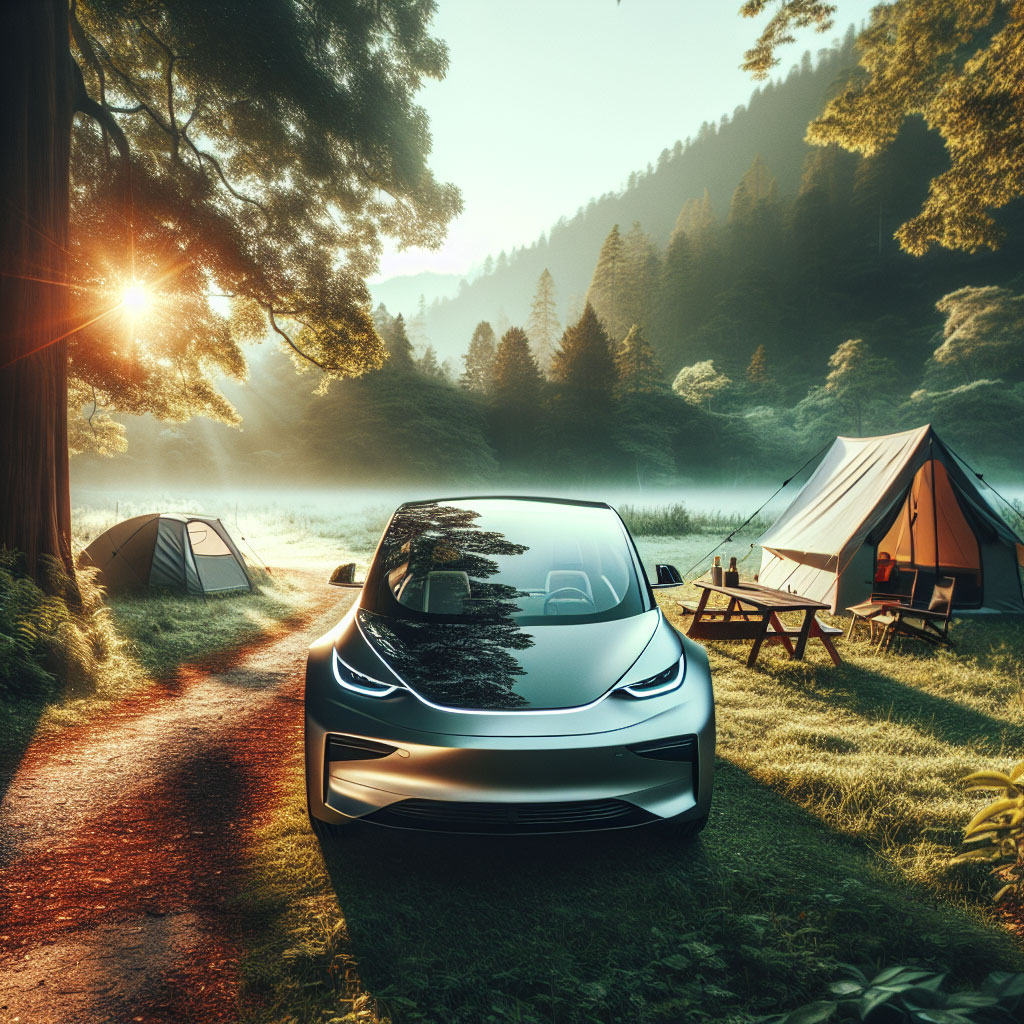
If you have visited a popular campsite in Australia over the last decade, you know the sound. The serenity of the bush is shattered at 5:00 PM by the drone of a petrol generator kicking into life so someone can run their microwave. It’s noisy, it smells, and quite frankly, it’s obsolete.
Welcome to the silent revolution of camping.
Thanks to a technology called Vehicle-to-Load (V2L), your new electric vehicle is no longer just a mode of transport; it is a massive, silent power bank on wheels. Whether you are running a glamping setup with an espresso machine and fairy lights, or just keeping the kids’ iPads charged during a rainy week in Wilsons Promontory, V2L changes everything.
At EV Evolution, we believe this feature is the single biggest lifestyle upgrade an EV offers. Here is your ultimate guide to ditching the gas bottle and camping with watts.
🔌 What is V2L?
In simple terms, Vehicle-to-Load allows your EV to take the high-voltage DC energy stored in its massive battery, convert it back into standard AC electricity, and pump it out through a regular 240V household socket.
It turns your car into a power station.
Most V2L systems in Australia are rated to output between 2.2kW and 3.6kW. To put that in perspective, a standard Honda portable generator outputs about 2kW. Your car can comfortably outperform a petrol generator without a drop of fuel or a decibel of noise.
⛺ The Glamping Upgrade: What Can You Run?
The beauty of V2L is that it democratizes luxury camping. You aren’t limited to 12V appliances anymore. You can bring the kitchen sink (and the appliances next to it).
Here is a typical “High-Voltage” campsite setup:
- The Morning Brew: A proper Breville or Sunbeam espresso machine (1200W). No more instant coffee.
- The Kitchen: A portable single-burner induction cooktop (1500W) or a multi-cooker/air fryer. Boil water in an electric kettle (2000W) in 2 minutes, not 10.
- The Comfort: Electric blankets for chilly desert nights, a blow-up mattress pump, or even a small fan heater.
- The Vibe: String up 50 metres of LED fairy lights, power a Bluetooth boombox, and keep a projector running for an outdoor movie night against the side of the tent.
The Golden Rule: Watch your total wattage.
If your car is rated for 3.6kW (3600 Watts), you can run an induction cooktop (1500W) and a coffee machine (1200W) simultaneously (Total: 2700W). But if you try to add a hair dryer (2000W) to the mix, you will trip the system.
🚙 The Contenders: Which Cars Have V2L?
Not all EVs are created equal. While Tesla is famously late to the V2L party (only the Cybertruck has it natively so far), the Asian manufacturers have embraced it as standard.
1. Hyundai (The Ioniq 5, Ioniq 6, Kona Electric)
- The Setup: Hyundai offers the slickest integration. Many models feature an internal 240V socket under the rear seats (perfect for charging laptops while driving) and an external adapter that plugs into the charge port.
- Output: A robust 3.6kW (15 Amps).
2. Kia (EV6, EV9, EV5, Niro EV)
- The Setup: Like their Hyundai cousins, Kia models are V2L powerhouses. The massive battery in the Kia EV9 (99.8kWh) could theoretically power a standard campsite for weeks without needing a recharge.
- Output: 3.6kW (15 Amps).
3. BYD (Atto 3, Seal, Dolphin, Sealion 6)
- The Setup: BYD includes V2L as standard across almost the entire range—even on the budget-friendly Dolphin. They provide a “power strip” adapter that plugs into the external charge port.
- Output: Generally rated at 2.2kW to 3.3kW (10-15 Amps) depending on the model and adapter.
4. MG (MG4, MG ZS EV, MG S5)
- The Setup: MG has democratized V2L, making it available on their entry-level models. It usually requires purchasing a V2L adapter separately (check with your dealer).
- Output: Typically 2.2kW (10 Amps).
🔋 EV Evolution Angle: Will I Drain My Battery?
This is the number one fear: waking up to a perfectly brewed coffee but a dead car.
Relax. You can’t.
Every V2L-capable car allows you to set a discharge limit in the infotainment screen.
- Example: You set the limit to 20%.
- The car will power your campsite all weekend, but as soon as the battery drops to 20%, the V2L system cuts power automatically.
- This ensures you always have enough “juice” reserved to drive to the next charger.
The Efficiency Reality:
Camping uses surprisingly little power. Running lights, charging phones, and cooking two meals a day might use 2-3kWh per day. On a 60kWh battery (like in a BYD Atto 3), that is less than 5% of your battery per day. You could camp for a week and still have plenty of range left.
🤖 Join the Evolution: Find Your Power Station
The market is flooded with electric SUVs, but finding one with V2L and a sub-$60k price tag takes research. Do you know which trim level of the Kia EV5 includes the V2L adapter in the box?
Don’t buy a car that can’t cook your dinner.
At EV Evolution, we have trained our AI-Powered Chatbot with the feature lists of every EV in Australia.
Ask the Chatbot today:
- “Give me a list of V2L-capable SUVs under $60,000 in Australia.”
- “What is the V2L wattage limit on the BYD Atto 3 vs. MG4?”
- “Does the Tesla Model Y have V2L in 2026?”
About EV Evolution
EV Evolution is the leading online platform dedicated to Australian electric vehicle owners and enthusiasts. We foster a vibrant community, delivering essential EV news and insights, and enhancing user engagement through our innovative, AI-powered chatbot for dynamic discussions. Our mission is to empower Australian electric vehicle owners and enthusiasts by fostering a vibrant, AI-driven online community that connects, informs, and advances the nation’s electric vehicle landscape.
