

Over the last few weeks, we’ve talked a lot about the great Aussie road trip. We’ve mapped out the chargers along the Pacific Highway and proved that taking your electric vehicle down the Great Ocean Road or up to the snow is an absolute breeze.
But let’s be brutally honest for a second. While fast-charging networks like Evie, Chargefox, and Tesla are incredible for weekend getaways, relying on them for your daily commute is missing the entire point of owning an EV.
If you are picking up an electric car on a novated lease to maximize your FBT tax savings, the real financial magic doesn’t happen on the highway. It happens in your driveway.
Here at EV Evolution, we get asked the same question every single day: “What is the actual cost to charge an electric car at home?” If you set it up correctly, the answer is less than the price of your morning flat white. Let’s break down the real 2026 math of the EV home charging cost Australia, and why switching your electricity plan is the ultimate financial cheat code.
🛣️ Highway Charging vs 🏡 Driveway Charging
When you plug into an ultra-rapid 350kW fast charger on a road trip, you are paying for extreme convenience and speed. Currently, major public networks charge anywhere from 60c to 85c per kilowatt-hour (kWh). At those rates, “filling up” a Tesla Model Y might cost you around $40 to $50. It’s still cheaper than petrol, but it’s a premium price.
Your house, however, is a different story.
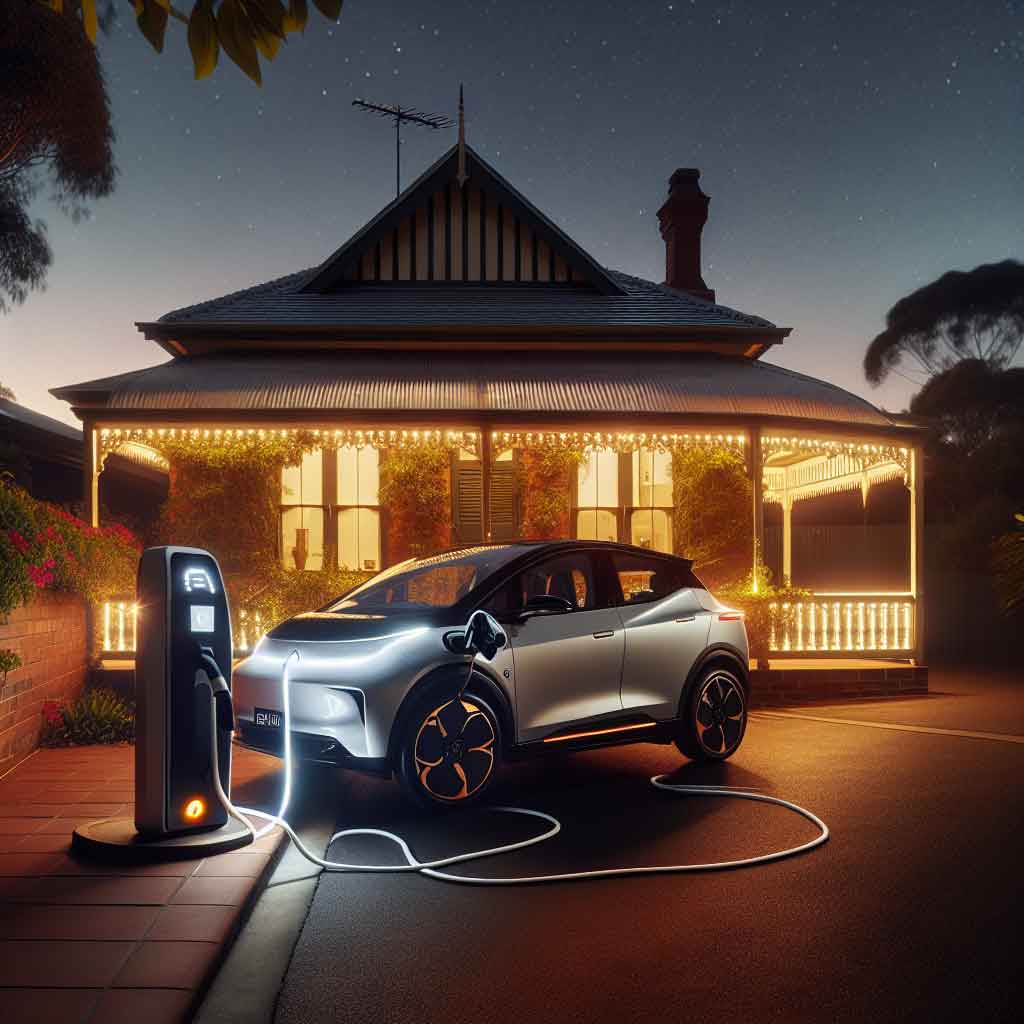
When you charge at home, you aren’t paying a middleman for speed. You are simply buying raw electricity from the grid. And thanks to specialized off-peak EV electricity tariffs rolling out across Australia in 2026, energy retailers are practically giving electricity away while you sleep.
💡 The 2026 EV Energy Plans Explained
Energy retailers desperately want you to charge your car overnight when the grid is quiet, rather than at 6:00 PM when everyone is cooking dinner. To encourage this, they have created dedicated EV “Time of Use” (TOU) plans that slash the price of power in the early hours of the morning.
Here are two of the biggest examples right now in 2026:
- AGL’s Night Saver EV Plan: If you have a smart meter, AGL will drop your electricity rate to a staggering 8c/kWh between midnight and 6:00 AM.
- OVO Energy’s The EV Plan: OVO offers a super off-peak rate of 6c to 8c/kWh (depending on your state) between midnight and 6:00 AM. They even offer a separate “Free 3” plan that gives you 3 hours of literally free electricity in the middle of the day to soak up excess solar from the grid.
The “Cup of Coffee” Math
Let’s say you drive a BYD Atto 3 (with a 60kWh battery) and you pull into your garage completely empty. If you set your car’s computer to only charge between midnight and 6:00 AM on AGL’s 8c/kWh rate, a mathematically complete 0% to 100% “full tank” will cost you exactly $4.80.
You will get roughly 400km of city driving for less than a five-dollar note.
🗣️ What Real Aussies Are Saying on Reddit
The smartest EV drivers in Australia don’t even think about the charging process anymore. They plug the car in when they get home, the car waits until midnight to start drawing power, and they wake up with a full tank.
If you jump onto r/AustralianEV to look at discussions surrounding OVO and AGL plans, the feedback is incredible. One user discussing their OVO Energy setup noted:
“All your energy use in that window is 6c per kWh. I have an automation in place that tops up my battery at that time, and have time shifted several household appliances… I managed to meet 96% of my total grid electricity demand with super off peak power. Pretty stoked with it to be honest.”
Over on r/AusFinance, when someone asked if EVs were still cheaper than petrol hybrids, the community was quick to correct the assumption that people use fast chargers every day:
“I get 8c/kWh 12pm-6am… It’s much much much cheaper than petrol. Unless you’re going 50km+ each way to the office you can get by with only charging a couple times a week anyway. DC fast charging is for road trips only… I either pay $0.08/kWh overnight or about $0.28/kWh during the day.”
Another user summed it up perfectly:
“In 2023 I did 96% of my charging at home, 4% at campsites and 0% at fast chargers… I mostly charge overnight though and it’s about $5 to charge.”
🤖 Calculate Your Exact Home Charging Costs
If you are driving a petrol car right now, you are likely spending $80 to $120 a week on fuel. Switching to an EV and a smart home energy plan can put thousands of dollars back into your pocket every year.
Wondering what it costs to fill up an EV on your specific energy bill? Drop your electricity rate into our AI Charge Cost Calculator below to see your exact savings.