



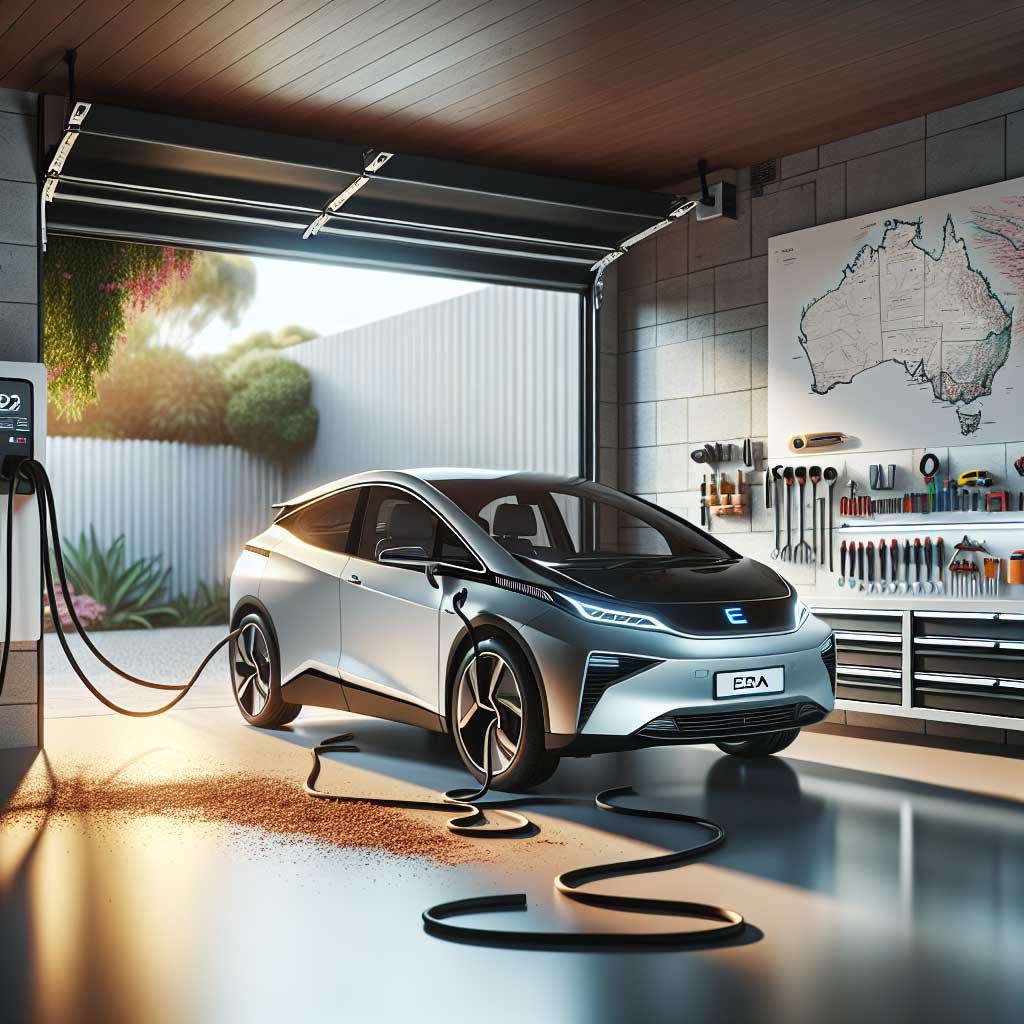
Imagine waking up every morning, strolling out to your garage with your flat white in hand, and finding your car “full” and ready to go. No detours to the smelly petrol station, no staring at the digital board hoping the price hasn’t jumped another 20 cents, and zero “range anxiety” for the day ahead.
In February 2026, this isn’t a futuristic dream; it’s the standard morning routine for thousands of Australians. As the EV evolution gathers pace, the real power move isn’t just buying the car—it’s owning the “fuel station” in your own garage.
But if you’re still “trickle charging” from a standard wall plug or relying solely on public hubs, you’re missing out on the true magic of EV ownership. Today, we’re deep-diving into home EV charger installation in Australia, breaking down the EV charger cost, and exploring why smart charging is the secret to a fatter bank account.
The “Fuel Station” in Your Garage: Why Home Charging Wins
Let’s be real: public charging is great for road trips, but for daily life, nothing beats the convenience of home. Beyond the “lazy factor,” the financial logic is brutal for the petrol industry.
When you charge at home, you aren’t just saving time; you’re hacking your cost of living. By using our EV fuel savings calculator, most Aussie drivers are discovering that they can slash their “fuel” bill by up to 70% compared to a petrol-guzzling SUV. When you combine that with off-peak electricity rates or a rooftop solar setup, you’re essentially driving for the price of a few meat pies a week.
💰 Counting the Coins: What is the Real EV Charger Cost in 2026?
One of the first questions we get at EV evolution is: “How much is this going to set me back?” In 2026, the market has matured, and the prices have stabilized. You aren’t just paying for a plastic box; you’re paying for a sophisticated piece of power electronics and a licensed professional to make sure your house doesn’t go “bang.”
The Hardware (The Wallbox)
A quality Level 2 AC wallbox in Australia currently ranges from $750 to $2,500.
- Entry-Level (e.g., Tesla Wall Connector): Roughly $750 – $800. These are reliable, sleek, and perfect for simple overnight top-ups.
- Mid-Range Smart Chargers (e.g., Zappi, Wallbox Pulsar Plus): Around $1,200 – $1,600. These offer better app integration and solar-tracking features.
- Premium/High-Power Units: $2,000+. These often include three-phase capabilities (up to 22kW) and advanced load balancing.
The Installation (The Sparky)
This is where people often get caught out. Home EV charger installation in Australia requires a licensed electrician to run a dedicated circuit from your switchboard to your garage or driveway.
- Standard Install: If your switchboard is close to your car and has enough “room” for a new circuit, expect to pay $700 – $1,200.
- Complex Install: If you need trenching, a switchboard upgrade, or long cable runs (over 15 metres), costs can climb to $2,000 – $3,500.
Pro Tip: Always get a fixed-price quote. In 2026, many specialized EV installers offer “standard installation” packages that take the guesswork out of the final bill.
⚡ Level 1 vs. Level 2: Why the Wallbox Matters
You might be thinking, “Can’t I just use the 10-amp ’emergency’ cable that came with the car?” Technically, yes. But that’s like trying to fill a swimming pool with a garden hose. A standard wall plug (Level 1) adds about 10–15km of range per hour. If you’ve just come home from a long day in a BYD Sealion 7 with a 10% battery, you’ll be waiting nearly two days for a full charge.
A dedicated Level 2 Wallbox (7kW single-phase) ups the ante significantly, adding about 40–50km of range per hour. For most Aussies, that means a totally flat battery is back to 100% while you sleep. You can use our EV charging time calculator to see the exact difference for your specific car model.
🧠 The Smart Charging Revolution
In 2026, we don’t just “charge”—we smart charge. A smart charger is connected to your home Wi-Fi and communicates with your car and the grid.
Why do you need a “Brainy” Charger?
- Off-Peak Automation: You can plug in at 6 PM, but the charger will wait until 11 PM to start, soaking up the cheapest “off-peak” rates without you lifting a finger. Check out our EV charge cost tool to see how much you save by shifting your habits.
- Solar Soaking: If you have solar panels, a smart charger can track your excess generation and “divert” that free sunshine directly into your car battery instead of sending it back to the grid for a pittance.
- Load Balancing: If you’re running the aircon, the oven, and the dryer all at once, a smart charger will “throttle” its speed so you don’t trip the main breaker of your house.
🛠️ Top Tips for a Smooth Installation
Before you call the sparky, here’s the EV evolution checklist for success:
- Check Your Switchboard: If your house was built before the Sydney Olympics, you might need a switchboard upgrade. Modern EVs pull a lot of current (32 Amps), and an old board can get grumpy.
- Wi-Fi Strength: Smart chargers need a signal. If your garage is a “dead zone,” consider a Wi-Fi extender or an ethernet run.
- The “Port” Factor: Check where your car’s charging port is. Is it on the front, the rear-left, or the rear-right? Make sure the cable (usually 5m or 7.5m) can reach easily without creating a trip hazard.
- Tethered vs. Untethered: A “tethered” charger has the cable permanently attached (easy for daily use). An “untethered” charger has a socket, meaning you provide your own cable (neater look, more flexible for different car brands).
🤖 Still Have Home Charging Questions? Ask the Expert
The world of electrical standards and “Amps vs Volts” can get confusing quickly. Should you upgrade to three-phase power? Is a Tesla Wall Connector compatible with your new Polestar 4?
Start the conversation with the EV evolution AI Agent. Our AI isn’t just a bot; it’s a specialized 2026 consultant that knows every quirk of the Australian grid and every spec of the 150+ models now on the road. You can ask it:
- “What is the best smart charger for a home with a 6kW solar system in Melbourne?”
- “Do I need to upgrade my switchboard for a 7kW charger in an older Queenslander home?”
- “How does the EV vibe check help me decide between home charging and public hubs?”
- “Can you explain the current Western Australian rebates for home EV charger installation?”
The Verdict: Your Future Self Will Thank You
Installing a home wallbox is the single biggest “quality of life” upgrade you can make as an EV owner. It turns your car into an appliance as simple as your smartphone—plug in, sleep, and wake up with the freedom to go anywhere.
Ready to find the perfect setup for your driveway? Head over to our EV fuel savings calculator to see the ROI for yourself, or chat with our AI Agent to get a personalized installation plan today.
About EV Evolution
EV Evolution is Australia’s authoritative strategic platform for electric vehicle market, dedicated to providing a high-fidelity knowledge base for the next generation of drivers. In a year defined by the Federal statutory review of FBT exemptions and the rapid arrival of record-breaking affordable models, we serve as your professional co-pilot to ensure every automotive decision is data-driven and future-proof. Our EV Strategy Suite—including the EV Tax Savings Estimator, Vibe Check Tool, and 24/7 AI Strategy Agent—empowers young professionals and families to navigate complex technical and regulatory shifts with total transparency. At EV Evolution, we don’t just track the market, we provide the strategic roadmap for your transition to the new electric standard.
