



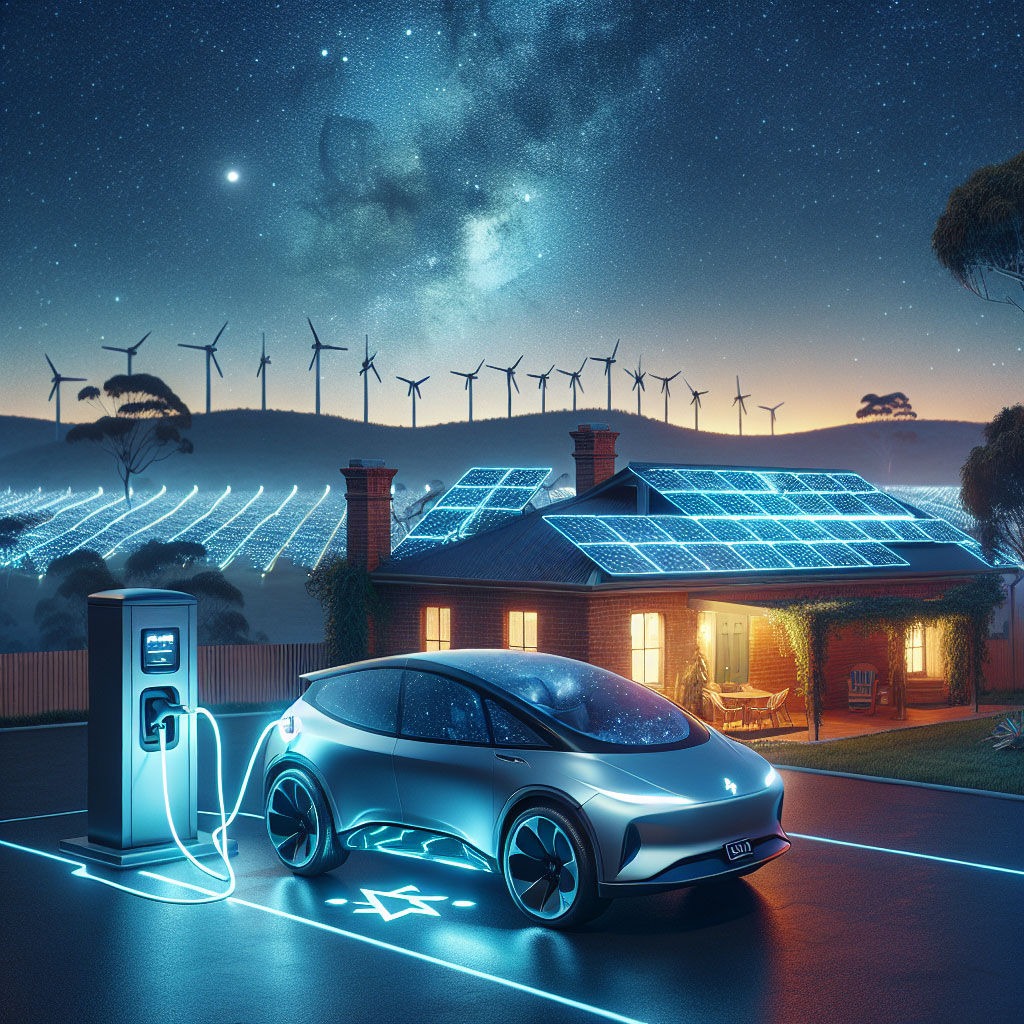
If you’ve walked through any Australian suburb lately, you’ve seen it: a shimmering sea of blue and black glass on every second roof. Australia leads the world in rooftop solar penetration, with over 3.6 million homes harvesting the sun. But for a long time, we’ve been playing a losing game with the retailers. We sell our pristine, green energy to the grid for a measly 5 cents, only to buy it back at 7 PM for 30 cents to run the dishwasher.
At EV Evolution, we call this the “Solar Trap.” But in 2026, the trap has been sprung. The rise of the Electric Vehicle has turned the humble home solar system from a “bill-saver” into a “fuel-refinery.” When you pair a 2026 EV with a smart charging strategy, you aren’t just driving a car; you’re driving a vehicle powered by 150 million kilometers of wireless energy transmission—straight from the sun.
Here is how to master the math of Solar Synergy and effectively drive for free.
☀️ The 10 AM Sunday Strategy: The Math of Freedom
To understand why Solar Synergy is so powerful, we have to look at the “Opportunity Cost” of your electricity. Let’s look at a typical Sunday morning in Sydney, Brisbane, or Melbourne in late 2025.
Scenario A: The Old Way (Exporting to Grid)
It’s 10:00 AM. Your 6.6kW solar system is pumping out 5kW of excess power. You aren’t home, or you’re just relaxing. That power flows back to the grid. Your retailer pays you the IPART benchmark feed-in tariff (FiT), which for the 2025-2026 period sits at roughly 4.8 to 7.3 cents per kWh.
- Your Gain: ~30 cents per hour.
Scenario B: The EV Evolution Way (Solar Soaking)
You plug in your EV at 10:00 AM. Instead of exporting that 5kW, you “soak” it into your car’s battery. By doing this, you are avoiding the need to charge from the grid later tonight at the peak rate of 30 to 45 cents per kWh.
- Your “Saving”: You just effectively bought “fuel” for 5 cents (the lost FiT) instead of 35 cents.
- The Result: You are driving at an 85% discount compared to grid charging, and a 100% discount compared to a petrol car.
In 2026, “Solar Soaking” isn’t just a hobby for tech-heads; it’s the primary way Australians are de-risking themselves from volatile global energy prices.
🧠 Why a 7kW Smart Charger is Your Best Investment
If you plug your car into a standard 10A power point (a “Granny Charger”), you’re only pulling about 2kW. If your solar is producing 5kW, you’re still wasting 3kW by sending it back to the grid for a pittance.
This is where the 7kW Smart Charger comes in. In 2026, models like the Zappi V2, Smappee, and the Tesla Wall Connector (with Solar Sync) have become the “brains” of the Australian garage.
1. Dynamic Load Balancing
A smart charger “talks” to your solar inverter. If a cloud passes over and your solar output drops from 5kW to 2kW, the charger instantly throttles the car’s intake so you don’t accidentally start pulling expensive power from the grid.
2. “Green Only” Modes
Most 2026 smart chargers feature a “Eco+” or “Solar Only” mode. You can plug the car in on a Tuesday and tell it: “Only charge when there is excess solar.” The car might take three days to fill up while you’re working from home, but every single kilometer added will have cost you exactly zero dollars in grid fees.
3. Future-Proofing for 2026 and Beyond
As we move into 2026, Australian retailers are introducing “Solar Clogs”—times where the grid is so full of solar that they might actually charge you to export. Having a 7kW smart charger allows you to act as a “grid sponge,” soaking up that excess and keeping the system stable while keeping your wallet full.
📊 The 2026 “Free Range” Calculation
Let’s get practical. The average Australian commute is roughly 35km to 40km per day. To be safe, let’s aim for 50km of range.
Most modern EVs (like the 2025 Tesla Model 3 or BYD Atto 3) have an efficiency of roughly 15kWh per 100km.
- To get 50km, you need 7.5kWh of energy.
In most parts of Australia, a single 415W solar panel produces about 1.6kWh to 1.8kWh per day (averaged across the year).
- The Math: To “fuel” your daily 50km drive purely on sunshine, you only need about 4 to 5 dedicated solar panels.
If you have a standard 6.6kW system (about 16 panels), you already have more than enough “roof real estate” to power your house and your car, provided you charge during the daylight hours.
🇦🇺 Regional Focus: NSW, VIC, and QLD
The “Solar Synergy” benefit varies slightly depending on where you park:
- Queensland: With the highest solar penetration and a generous “Economy Tariff” (T33) still available as a backup, QLD remains the best state for solar-EV integration.
- New South Wales: As of late 2025, the shift toward “Time of Use” (ToU) pricing is aggressive. Charging your EV at 10 AM is now vastly more profitable than charging at 6 PM.
- Victoria: The 2025 updates to the Victorian Default Offer have made grid power more expensive during peak times, increasing the ROI (Return on Investment) of a smart solar charger to less than 3 years for most households.
🏁 EV Evolution Angle: The Sun is Your Service Station
At EV Evolution, we believe that the true promise of the electric shift isn’t just about the car; it’s about sovereignty. For the last century, we’ve been dependent on foreign oil and localized petrol monopolies.
Solar Synergy changes the power dynamic. When you pull into your driveway in 2026, you aren’t just parking a vehicle—you’re docking a mobile storage unit. You are your own fuel supplier. You are your own infrastructure.
The sun doesn’t send you a monthly bill. It doesn’t care about global supply chains. It just shows up at 6 AM and asks if you’re ready to drive.
🤖 Join the Evolution: Calculate Your Sunshine Specs
Every roof is different. A house in Hobart needs a different setup than a penthouse in Perth. You need to know exactly how much “roof juice” you need to never visit a petrol station again.
Don’t guess your energy future. Let the AI crunch the numbers.
At EV Evolution, we’ve integrated the latest 2025 NASA solar irradiance data for every Australian postcode.
Ask the Chatbot today:
- “Calculate how many solar panels I need to charge 50km of range per day in [Your Postcode].”
- “Which 7kW Smart Chargers are compatible with a Fronius inverter in 2026?”
- “What is the ROI of adding 3kW of solar specifically for an EV in Melbourne?”
- “Explain how to set up ‘Eco+’ mode on a Zappi charger for a BYD Seal.”
About EV Evolution
EV Evolution is the leading online platform dedicated to Australian electric vehicle owners and enthusiasts. We foster a vibrant community, delivering essential EV news and insights, and enhancing user engagement through our innovative, AI-powered chatbot for dynamic discussions. Our mission is to empower Australian electric vehicle owners and enthusiasts by fostering a vibrant, AI-driven online community that connects, informs, and advances the nation’s electric vehicle landscape.
