


For years, Australia often felt like an afterthought in the global electric vehicle rollout. We waited longer for models, struggled with sparse infrastructure, and watched the rest of the world accelerate ahead. But in November 2025, the script flipped.
Tesla has officially installed its 75,000th global Supercharger stall, and in a massive nod to our growing EV market, this historic piece of hardware wasn’t placed in California, Shanghai, or Berlin.
It was installed in South Hobart, Tasmania.
At EV Evolution, we believe this is more than just a symbolic gesture; it is a definitive statement that Australia has moved from the periphery to the main stage of the electric transition. Here is everything Australian EV enthusiasts need to know about this major milestone and what it means for our local charging network.
🌏 The Milestone: Global Scale, Local Address
To be clear, the “75,000” figure refers to the total number of Tesla Supercharger stalls worldwide. Reaching 75,000 stalls is a staggering achievement of logistical dominance, especially considering Tesla hit the 50,000 mark just over two years ago in September 2023. The pace of deployment is accelerating exponentially.
However, the “Milestone Unit”—the actual physical charger representing this number—is proudly Australian.
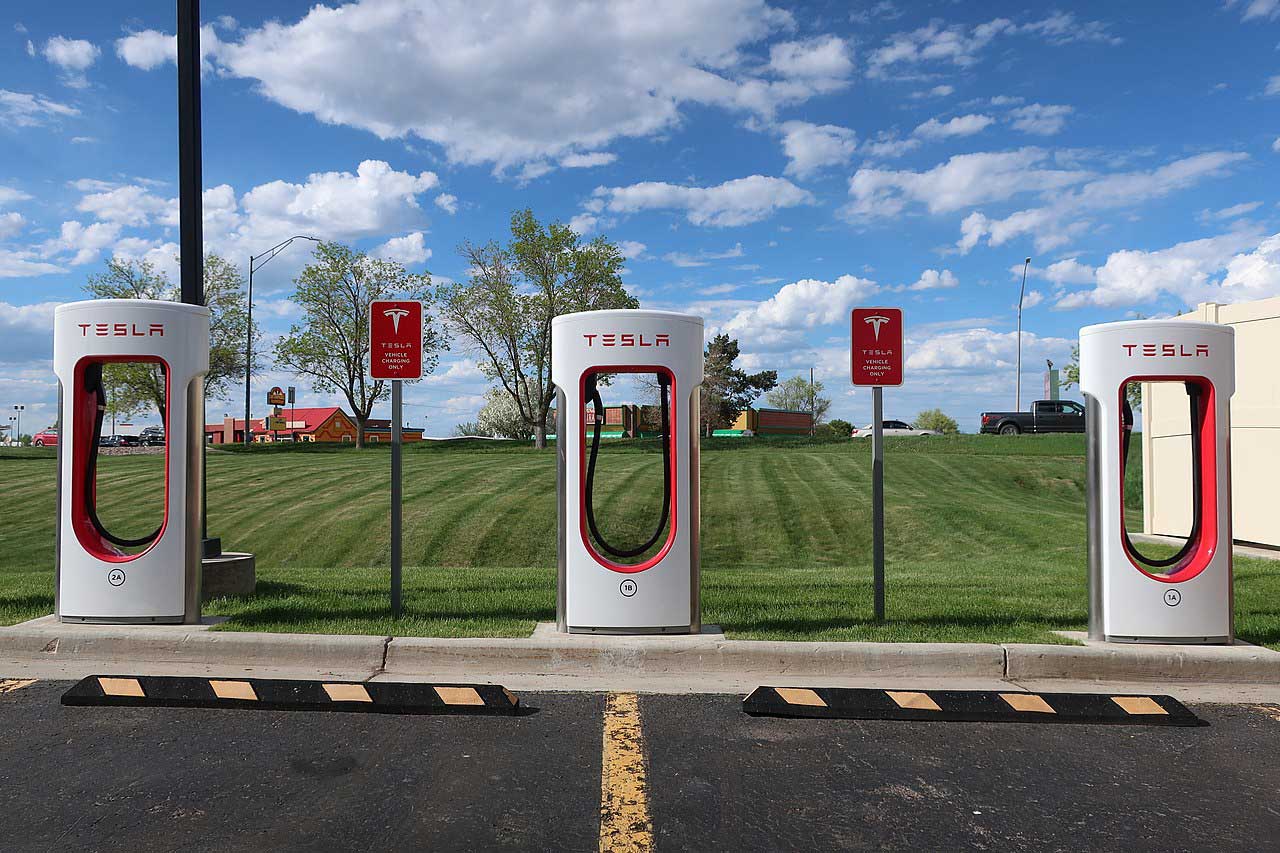
Located at the South Hobart Smart Store on Cascade Road, the unit is impossible to miss. Unlike the standard white-and-red Tesla livery, this commemorative V4 Supercharger is finished in a striking “Glacier Blue” custom paint job. It features a commemorative plaque reading “Supercharger No. 75,000” alongside the program’s lifespan “2012 – 2025.”
This follows a Tesla tradition of “Easter egg” chargers for major milestones:
- 50,000th Stall: Painted “Ultra Red” and located in California.
- 60,000th Stall: Featuring a unique Cyber-pattern design, located in Japan.
- 75,000th Stall: Glacier Blue, located in Tasmania, Australia.
⚡ The Tech: What is a V4 Supercharger?
The milestone unit in Hobart is a V4 Supercharger, the latest generation of Tesla’s charging hardware. For Australian enthusiasts, the rollout of V4 technology is arguably more exciting than the milestone number itself.
Why V4 Matters for Aussie Drivers:
- Longer Cables: The most practical upgrade. V4 cables are significantly longer (approx. 3 metres) than the short V2/V3 cables. This is a game-changer for non-Tesla EVs (like BYD, Kia, and Hyundai), whose charge ports are often located in different positions. It eliminates the need to park awkwardly or block multiple bays just to plug in.
- Future-Proof Speeds: While currently often software-limited to match V3 speeds (250kW), the V4 architecture is built for up to 500kW and supports high-voltage architectures (up to 1000V). This means 800V cars like the Hyundai Ioniq 5 and Porsche Taycan will eventually be able to charge much faster at these sites.
- Payment Terminals: V4 stalls are designed with screens and contactless payment card readers, simplifying the process for casual users who may not have the Tesla app.
🇦🇺 State of the Nation: The Australian Supercharger Network in 2025
While the 75,000th stall is a global trophy, the local network is the daily reality for Australian drivers. As of late 2025, the Tesla Supercharger network in Australia has matured into the country’s most reliable charging backbone.
Key Australian Stats:
- Total Sites: Over 130 locations are now operational across the country.
- Open Access: Approximately two-thirds of these sites are now open to non-Tesla EVs, making Tesla the de facto charging provider for the entire industry.
- Largest Hub: The title for Australia’s largest Supercharger site currently belongs to Goulburn, NSW, which boasts a massive 20 stalls, serving as a critical artery for the Sydney-Canberra-Melbourne corridor.
The choice of Tasmania for the 75,000th stall also highlights the rapid electrification of the island state, which has become a haven for EV road trippers thanks to its compact size and high density of fast chargers.
🔮 What This Means for the Future
Tesla’s decision to place such a significant global marker in Australia signals confidence in our local market. After years of policy uncertainty, Australian EV adoption has surged, and our infrastructure demands are finally being met with world-class hardware.
The arrival of more V4 sites will be critical in 2026 as the fleet of non-Tesla EVs grows. Vehicles like the Ford F-150 Lightning and Kia EV9 are physically large vehicles that struggle with older, shorter cables. The V4 is the universal solution that prepares Australia for a diverse electric future.
🤖 Join the Evolution
The world of EV charging is moving fast—literally. Between V3, V4, 800V architectures, and open-access sites, keeping up with where to charge and which car charges fastest can be a full-time job.
Don’t navigate the network alone.
At EV Evolution, we have integrated the latest Australian charging data into our intelligent tools. We encourage you to try out chatting with the EV Evolution AI chatbot today.
- “Where is the nearest V4 Supercharger to me?”
- “Which Tesla sites in NSW are open to my BYD Atto 3?”
- “Is the 75,000th charger in Hobart free to use?”
Our AI is trained on the latest real-time news and infrastructure updates to keep you powered up and moving.
About EV Evolution
EV Evolution is the leading online platform dedicated to Australian electric vehicle owners and enthusiasts. We foster a vibrant community, delivering essential EV news and insights, and enhancing user engagement through our innovative, AI-powered chatbot for dynamic discussions. Our mission is to empower Australian electric vehicle owners and enthusiasts by fostering a vibrant, AI-driven online community that connects, informs, and advances the nation’s electric vehicle landscape.
