

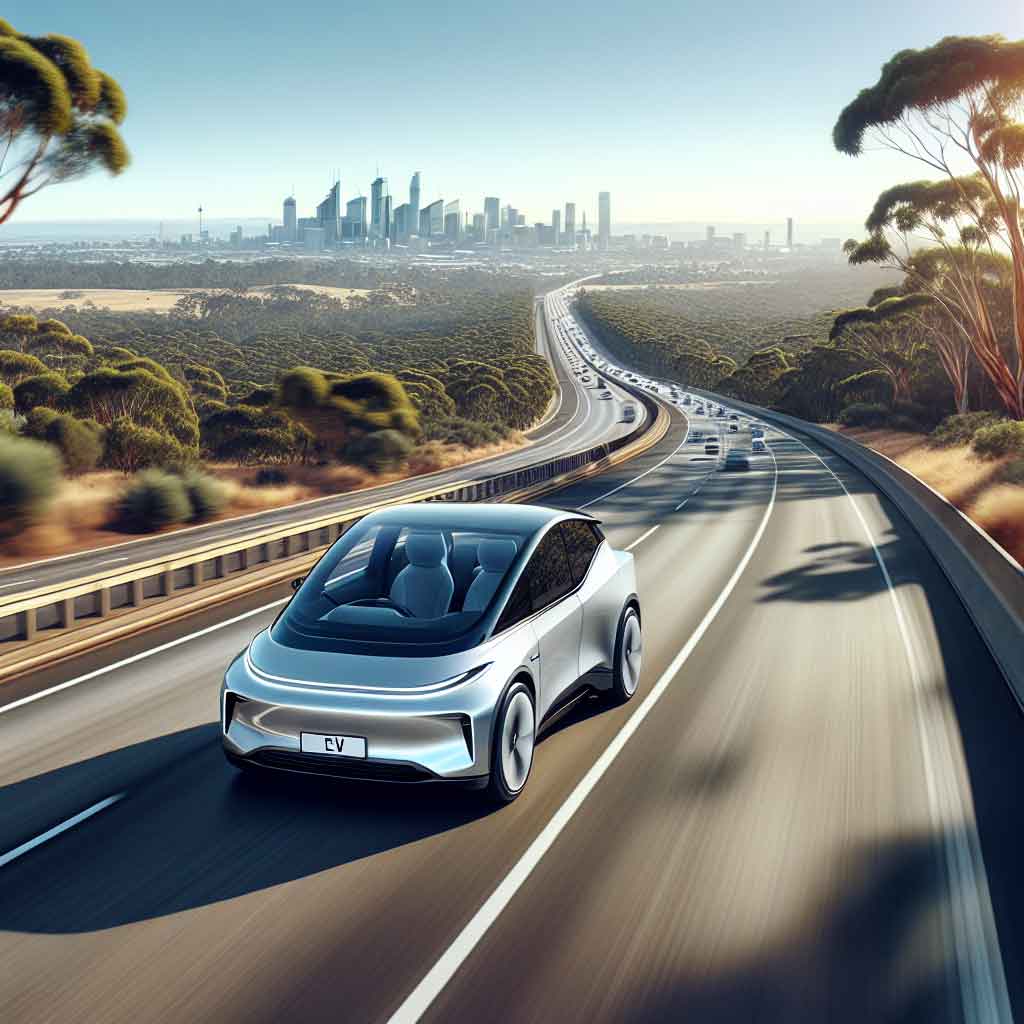
To understand the highway drop, you first need to understand why EVs are so heavily favoured in urban environments.
If you drive a traditional petrol or diesel car (an ICE vehicle), sitting in stop-start traffic is a nightmare for your fuel economy. Your engine is constantly idling, burning fuel just to keep running, and all your braking energy is lost as heat.
Electric cars flip this completely upside down:
- Zero Idling: When you stop at a red light in Sydney or Melbourne, an EV uses virtually zero energy. The motor simply switches off.
- Regenerative Braking: This is the magic trick. When you take your foot off the accelerator in traffic, the electric motor reverses its function. It acts as a generator, slowing the car down and pushing that kinetic energy back into the battery.
Because of this, EVs often exceed their advertised range in heavy city driving. But when the traffic clears and the speed limit goes up, the physics change.
🛣️ The 110km/h Reality: Fighting the Air
When you merge onto the highway and push the speedo up to 110km/h, you lose the two biggest advantages of an EV. You aren’t braking (so there’s no energy regeneration), and you are now fighting aerodynamic drag.
Aerodynamic drag doesn’t increase in a straight line; it increases exponentially. Pushing a two-tonne car through the air at 110km/h requires significantly more constant power than cruising at 60km/h.
You don’t just have to take our word for it. If you look at the highly active Australian EV communities on Reddit, owners are brutally honest about the WLTP vs real world range discrepancy.
In a recent discussion on r/AustralianEV regarding range anxiety, one Aussie driver broke down the math perfectly for their BYD Atto 3:
“WLTP is no good. So much depends on the efficiency of the car and driving conditions. E.g. my Atto 3 is WLTP rated for 420km. On the highway at 110km/h I get about 20kwh/100km energy use, roughly 300km… Stop-start city traffic splits the difference.”+1
Over on r/KiaEV3, drivers debating the “sweet spot” for highway speeds noted the exact same physical reality:
“Unlike combustion engines, there is no such sweetspot. Due to its efficiency, EV consumption increases with higher speed… 110km/h is ideal on highway, but highway speed range is usually never close to stated ranges by the manufacturer.”+1
It’s worth noting that petrol cars also lose efficiency at high speeds, but because petrol tanks hold so much dense energy, we rarely notice the drop. In an EV, where every kilowatt is displayed on your dash, the physics become very obvious.
📏 The “20% Highway Penalty” (Setting Realistic Expectations)
So, how do you plan an electric car road trip without getting stranded? You apply the EV Evolution golden rule.
Whenever you are planning a trip consisting mostly of 110km/h freeway driving (like hitting the Pacific Highway EV chargers), automatically deduct 20% from the car’s advertised WLTP range. * Advertised WLTP Range: 450km
- The 20% Penalty: -90km
- Your Real-World Highway Safe Range: 360km
If you know you have 360km of highly reliable highway range, you can easily plan a quick 15-minute top-up at an Evie, Chargefox, or open Tesla Supercharger without ever sweating over your battery percentage.
🤖 Don’t want to do the math yourself? Ask our AI.
We know that calculating kilowatt-hours and aerodynamic penalties isn’t exactly a fun way to start a holiday. That is exactly why we built the “Weekend Warrior” trip planner into the EV Evolution AI Agent.
Our AI is specifically programmed to automatically deduct the highway penalty for you, plotting a realistic, stress-free route using the latest Australian charging networks.
Just type ‘Map a trip from Sydney to Newcastle in a Polestar 2’ into the chat below, and our Weekend Warrior planner will do the heavy lifting for you!