



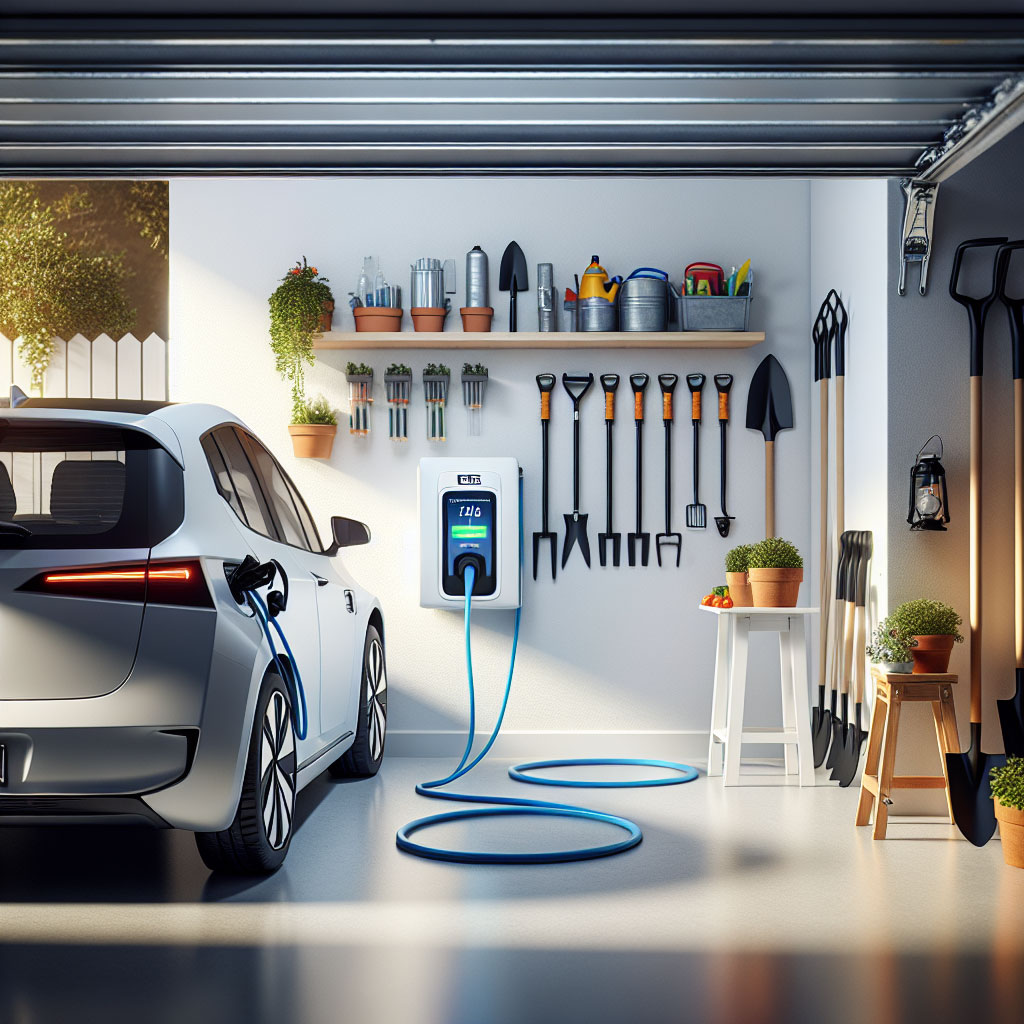
The moment you sign the papers on a new electric vehicle, you are immediately confronted with the next big question: “How am I going to charge this thing?”
The dealership pushes a glossy brochure for a $2,000 smart wallbox, the electrician quotes another $800 to $1,500 for installation, and suddenly, the incredible fuel savings you were excited about are overshadowed by an unexpected expense.
Many first-time buyers mistakenly believe that a dedicated wall charger is mandatory—the EV equivalent of a driveway petrol pump.
The truth? For a massive percentage of Australian drivers, the charger that comes free in the boot of your car—the trusty, simple cord you plug into a standard household power point—is all the charging infrastructure you will ever need.
At EV Evolution, we say: Save your money? Why 50% of Aussie EV owners are fine with a standard powerpoint.
🏡 The Numbers Don’t Lie: You Drive Less Than You Think
The entire decision hinges on one critical, often-overlooked data point: your actual daily driving distance.
According to the latest data from the Electric Vehicle Council and ABS, the average Australian drives only about 38 to 40 kilometres per day. That’s it. That’s the entire daily commute, school drop-off, and grocery run combined.
Now, let’s look at what the basic charging cable (affectionately known as the “Granny Charger” or “trickle charger”) can do:
The Granny Charger (Standard 10A Powerpoint)
This is the cable you plug into any regular wall socket in your garage or carport. It charges at a rate of approximately 2.3kW.
- Range Per Hour: Most modern EVs gain about 10km to 15km of range per hour of charging on a standard 10A socket.
- Overnight Haul: If you plug in at 7 PM and unplug at 7 AM (a typical 12-hour overnight charge), you add:$$10 \text{km/hr} \times 12 \text{ hours} = \mathbf{120 \text{ km} \text{ of range}}$$
The Conclusion for the Average Driver
If you drive 40km per day, and your Granny Charger adds 120km overnight, you are adding three times more range than you consumed that day.
You start every morning with a full battery (or close to it) and never think about charging until the weekend. If you only drove 40km, you only need to charge for about 4 hours to replace that energy. The rest of the time, the car is waiting, not charging.
🧱 The Wallbox (The Smart Investment)
So, if the Granny Charger is good enough, why does anyone spend $1,500 to $3,000 on a dedicated wall charger installation?
A wallbox (usually a 7kW or 11kW unit) is simply a Level 2 AC charger that is wired directly into your home’s main switchboard.
The Benefits of a Wallbox (7kW)
- Speed: It charges about 3 to 5 times faster than the Granny Charger, adding approximately 40km to 45km of range per hour.
- Safety & Convenience: It’s bolted to the wall, rated for continuous high-load charging, and doesn’t rely on the health of a potentially old power point.
- Smart Features: Most wallboxes are ‘smart.’ They can monitor energy consumption, integrate with solar panels (ensuring the car only charges from solar surplus), and shift charging times to take advantage of cheap off-peak power tariffs.
| Scenario | Granny Charger (2.3kW) | Wallbox (7kW) | Verdict |
| Daily Commuter (40km) | 4 hours to replace range | 1 hour to replace range | Tie: Both work perfectly. |
| Weekend Warrior (250km) | 20 hours to recharge | 6 hours to recharge | Wallbox Wins: Ready for Sunday driving. |
| Solar Owner | Cannot control solar use | Wallbox Wins: Smart integration for free charging. | |
| Upfront Cost | $\mathbf{\$0}$ (Included with car) | $\mathbf{\$1,500 – \$3,000}$ (Installed) | Granny Wins: Saves cash. |
EV Evolution Angle: Why You Might Still Want the Wallbox
The data is clear: if you are a city dweller with a regular 40km commute and you are not touring every weekend, keep the wallbox money in your pocket. You can always buy one later.
However, the Wallbox makes sense for two key reasons:
1. Solar Synergy (The Game Changer)
Australia has the highest per-capita solar adoption in the world. If you have solar panels, a smart wallbox (like a Zappi or a Wallbox Pulsar) is the only way to guarantee your car is only charging using the free, surplus energy generated during the day. This completely eliminates your fuel/charging cost. The wallbox pays for itself in savings.
2. The Weekend Haul
If you plan on driving 250km on Saturday for a day trip, you need to put that energy back in overnight to start fresh on Sunday. A Granny Charger would struggle, potentially needing 20 hours. A wallbox gets it done in 6 hours, ready for the next adventure.
The EV Evolution Recommendation: Start with the Granny Charger for the first three months. If you find yourself consistently needing to use public charging on the weekend because your home charge is too slow, then invest in the wallbox.
🤖 Join the Evolution: Crunch Your Personal Numbers
Are you thinking about an EV with a huge 77kWh battery? Or a smaller 45kWh city runabout? The required charging time changes dramatically.
Don’t buy a charger you don’t need.
At EV Evolution, we have trained our AI-Powered Chatbot on the charging curves and battery sizes of every major EV in Australia.
Ask the Chatbot today:
- “Calculate how many kilometres of range I get from a standard 10A socket overnight (12 hours) in a Kia EV6.”
- “What is the approximate cost of installing a Zappi solar-aware charger in Sydney?”
- “Will a 10A charger fully replace the range of a BYD Dolphin if I drive 50km per day?”
About EV Evolution
EV Evolution is the leading online platform dedicated to Australian electric vehicle owners and enthusiasts. We foster a vibrant community, delivering essential EV news and insights, and enhancing user engagement through our innovative, AI-powered chatbot for dynamic discussions. Our mission is to empower Australian electric vehicle owners and enthusiasts by fostering a vibrant, AI-driven online community that connects, informs, and advances the nation’s electric vehicle landscape.
