


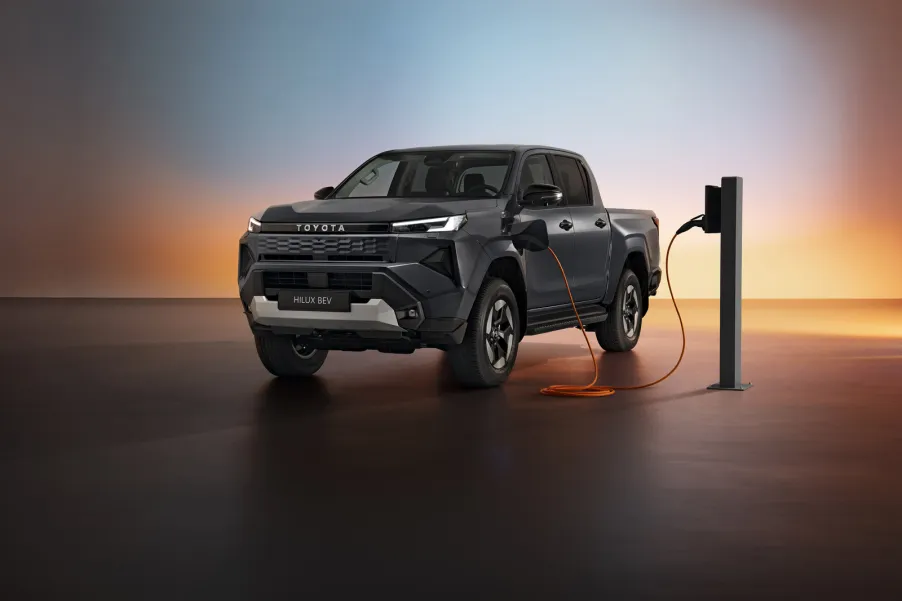
For generations, the Australian worksite has been defined by the rumble of the Toyota HiLux’s 2.8-litre turbo-diesel engine. It was the sound of reliability, durability, and a 3.5-tonne towing capacity that could conquer the Nullarbor.
That sound is about to change. It’s about to become… silent.
Toyota Australia has officially confirmed the imminent arrival of the HiLux BEV (Battery Electric Vehicle) in the first half of 2026. This is a monumental moment for the Australian automotive landscape, yet it comes with a massive, defining caveat: this is not the electric HiLux for the weekend adventurer, the long-haul caravan tower, or the outback explorer.
The Toyota HiLux EV is a specialized tool, purpose-built for fleets, mining companies, and urban trade operators who operate on predictable, short-distance routes. At EV Evolution, we’ve analysed the confirmed specifications and Toyota’s candid executive announcements to give tradies and fleet managers the definitive breakdown of the machine set to electrify the city grid.
🎯 The Fleet-First Strategy: Understanding the 240km Range
Toyota has been accused of arriving late to the electric ute party, but their strategy, as confirmed by executives, is rooted in pragmatism: The right solution for the right application.
Toyota Australia Vice President, Sean Hanley, made the positioning clear: the HiLux EV is for “short-distance operations that need the payload and passenger capacity and are able to be recharged easily and economically.”
The undeniable constraint confirming this is the 59.2kWh battery pack, which delivers a certified WLTP range of just 240km.
This range is a deliberate choice. A smaller battery means lower weight, which allows the HiLux EV to retain a competitive 715kg payload capacity—a critical factor for tradies hauling heavy tools and equipment. While this 240km figure places the HiLux BEV among the shortest-range electric vehicles on the Australian market (shorter even than the BYD Dolphin hatch), it is perfectly adequate for:
- Urban Tradies: Most tradies in major cities drive less than 150km a day.
- Government Fleets: Local council and utility service vehicles with fixed depot charging.
- Mining & Depot Use: Companies like BHP, who have been trialling the prototype, have access to on-site charging where the predictable, short loops of a mine site negate range anxiety.
The message is clear: If your job involves a 1,000km round trip, stick to the diesel or the forthcoming hydrogen FCEV. If your job site is within 100km of your home or depot, welcome to the silent revolution.
🛠️ Full Specifications: The Tradie’s New Toolkit
The HiLux BEV is a dual-motor, four-wheel-drive machine built on the new-generation HiLux’s robust chassis, but with significant electric-specific engineering.
Toyota HiLux BEV (SR/SR5 Dual Cab 4×4)
| Specification | Metric Value | Diesel 4×4 HiLux (Comparison) | Context for Tradies |
| Powertrain | Dual Electric Motors (e-AWD) | 2.8L Turbo-Diesel | Instant torque means easier starts with heavy loads. |
| Combined Output | 144kW / 473Nm | 150kW / 500Nm (Auto) | Torque is similar, but electric delivery is superior for low-speed control. |
| Battery Capacity | 59.2 kWh (Lithium-Ion) | N/A (80L fuel tank) | The defining constraint: short urban range, but lighter weight. |
| WLTP Driving Range | 240 km | ~1,000 km | Ideal for local work. Not suitable for regional/interstate travel. |
| Payload Capacity | 715 kg (Pre-homologation) | ~900kg – 1,000kg | Competitive enough for a full tray of tools and materials. |
| Braked Towing Capacity | 1,600 kg (Pre-homologation) | 3,500 kg | Major compromise. Cannot tow large caravans or heavy plant equipment. |
| DC Fast Charging | 150 kW (Peak) | N/A | Excellent charging speed for its battery size (10-80% in 15-20 mins). |
| Suspension | De Dion Rear Axle | Leaf Springs (Diesel) | Modern solution to maintain off-road capability while housing the battery. |
| Australian Launch | First Half 2026 | Launched Dec 2025 (Diesel/Hybrid) | Available in SR and SR5 dual-cab grades. |
The Torque Factor
While the peak power (144kW) and torque (473Nm) figures are slightly lower than the V-Active mild-hybrid diesel, the instantaneous delivery of electric torque is game-changing for a work vehicle. It allows for superior low-speed control, especially in difficult conditions. Furthermore, the electronic torque control provided by the dual motors offers capability “equivalent to driving in L4 [low range] in a conventionally powered vehicle.”
Charging and Downtime
For a tradie, downtime is money lost. The 150kW peak DC charging rate, allowing a quick 15–20 minute top-up, is a huge win. More importantly, the ability to simply plug in at the depot overnight, powered by inexpensive off-peak electricity, dramatically reduces running costs and eliminates trips to the petrol station.
💰 Pricing and the Hydrogen Future
While final Australian pricing is unconfirmed, Toyota has been pragmatic. Hanley stated the BEV will be “dearer than the diesel utes we have right now,” but insisted it “can’t be $100,000.” This suggests a likely price point in the $80,000 – $90,000 range. For fleets, this premium is quickly offset by:
- FBT Exemption: The Fringe Benefits Tax exemption for eligible electric vehicles.
- Low Running Costs: Minimal servicing and cheap “fuel.”
The Heavy-Duty Answer: Hydrogen FCEV
Crucially, Toyota is not abandoning the long-haul, heavy-duty market. The company has explicitly confirmed that a Hydrogen Fuel Cell Electric Vehicle (FCEV) HiLux will follow in 2028. This vehicle is expected to offer the 500km+ range and the heavy 3.5-tonne towing capacity demanded by regional and remote users, solidifying Toyota’s “multi-pathway” approach.
🏁 EV Evolution Verdict: A Specific Tool, Not a Universal Fix
The Toyota HiLux EV is the most honest electric workhorse launched in Australia to date. It is a calculated compromise. It sacrifices the diesel’s long legs and extreme towing capability to provide a high payload, robust 4×4 capability, and low operating costs for the specific demands of urban and fixed-route fleets.
It’s a huge step forward for sustainability on the worksite, but it requires the tradie to know their daily distance and their towing needs. This is the new, quiet champion of the city streets and the mine site—not the outback.
🤖 Tradie’s Advantage: Chat with the EV Evolution AI
Are you a tradie or a fleet manager wondering if the 240km range and 1,600kg towing capacity fit your business’s needs? Don’t rely on guesswork.
At EV Evolution, we’ve integrated all the confirmed Toyota HiLux EV specs, pricing estimates, and FBT rules into our AI-powered chatbot.
We encourage tradies to chat with our bot to get personalised answers and projections:
- Calculate Your Costs: “How much would the HiLux BEV cost my business over 3 years compared to a diesel SR5, factoring in the FBT exemption and electricity costs?”
- Range Analysis: “My daily route is 180km with an 800kg payload. Will the HiLux BEV manage this in winter?”
- Towing Reality: “What can I tow with 1,600kg that I currently tow with 3,500kg?”
About EV Evolution
EV Evolution is the leading online platform dedicated to Australian electric vehicle owners and enthusiasts. We foster a vibrant community, delivering essential EV news and insights, and enhancing user engagement through our innovative, AI-powered chatbot for dynamic discussions. Our mission is to empower Australian electric vehicle owners and enthusiasts by fostering a vibrant, AI-driven online community that connects, informs, and advances the nation’s electric vehicle landscape.
