


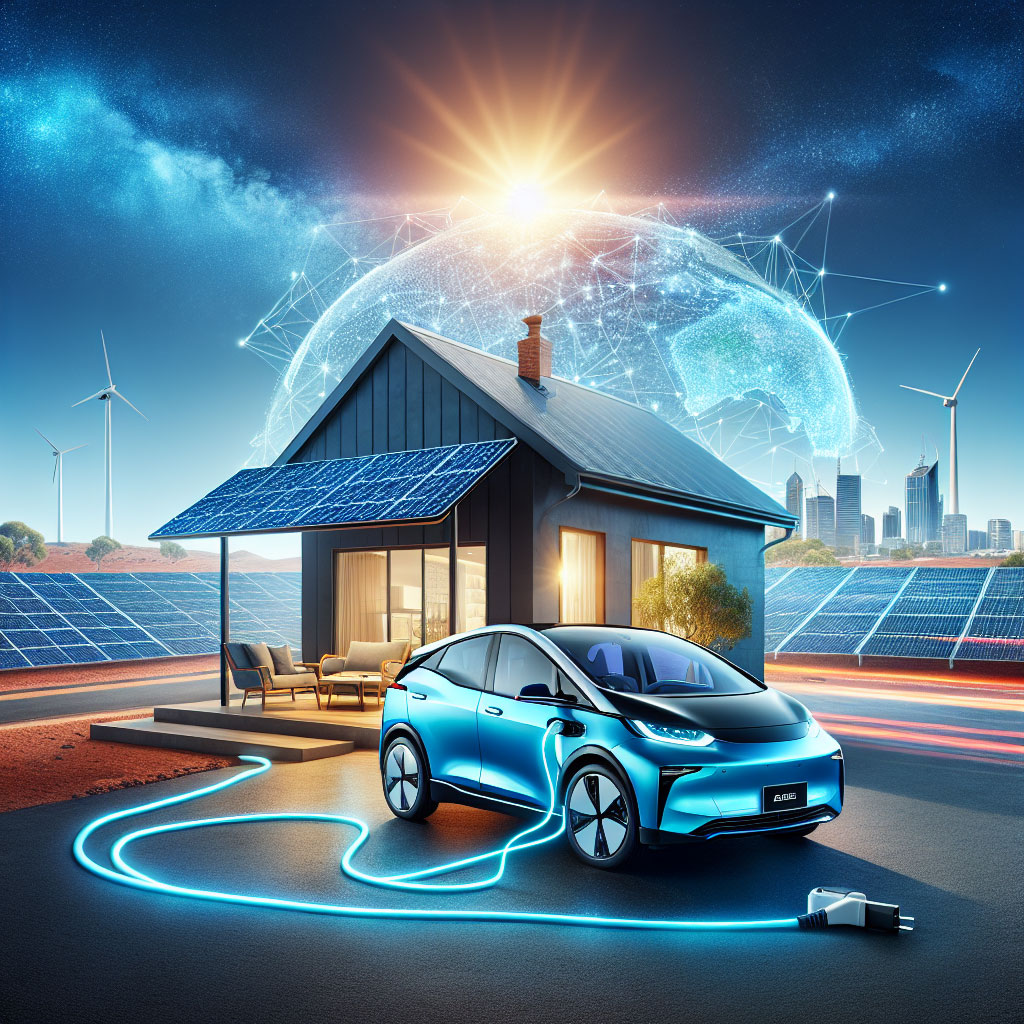
The electric vehicle (EV) revolution in Australia is moving beyond just transport. As more Australians embrace zero-emission driving, a quiet but powerful shift is occurring in the energy sector: the rise of Vehicle-to-Grid (V2G) technology. This is no longer a futuristic concept; by 2026, V2G is set to transform your EV from a simple vehicle into a valuable, revenue-generating energy asset—a “home battery on wheels” that could significantly offset your running costs, and potentially, the price of the car itself.
The core promise of V2G Australia is a financial one: use your EV’s massive battery to store cheap, renewable energy, and then either power your home or sell the surplus back to the grid when prices are high. Recent modelling from the Electric Vehicle Council suggests an EV owner participating in V2G could earn around $1,000 per year by exporting power during periods of peak demand. Coupled with the savings from using stored energy to power your home, the total benefit for savvy EV owners is becoming too big to ignore.
The Power of Your EV Battery Storage
A typical electric car battery holds between 60kWh and 100kWh of energy—enough to power the average Australian home for several days. Contrast this with the typical home battery storage system, which is often around 10kWh. Your EV parked in the driveway represents up to ten times the energy capacity of a standard static battery.
This immense storage potential is the foundation of the V2G revolution. When combined with rooftop solar, your EV can soak up excess daytime solar generation, which is often sold back to the grid for a low feed-in tariff, and then dispatch that energy when the sun goes down and electricity prices skyrocket. This functionality is technically known as Vehicle-to-Home (V2H) but is a critical step in the broader V2G ecosystem.
Vehicle-to-Home Technology: Your Personal Power Wall
While V2G Australia focuses on the utility of an EV to the wider electricity grid, the more immediate and tangible benefit for households comes from Vehicle-to-Home technology (V2H).
V2H allows your EV to power your house directly. For homes with solar, this is a game-changer. Instead of paying a high peak-rate for electricity in the evening, you simply draw power from your car, which you charged for free (or very cheaply) with solar during the day. In the event of a blackout, your V2H-enabled car can instantly act as a massive backup power supply, keeping the lights, fridge, and essential appliances running.
The integration of EV battery storage with smart home energy management systems is key. Retailers are currently developing software that will automatically manage this flow of energy—ensuring your car is charged and ready for your morning commute while optimising its energy exports to maximise your savings.
2026: The Commercial Tipping Point
The year 2026 is projected to be the true launchpad for V2G in the Australian residential market. While the technology itself is proven, its widespread adoption has been held back by regulatory frameworks and commercial availability. However, these barriers are rapidly dissolving:
1. Trial Launches: Australia’s major energy retailers, including AGL and Origin Energy, are launching landmark V2G trials in 2026. These programs are pairing customers with bi-directional chargers and V2G-compatible EVs (such as models from BYD, Kia, and Hyundai), with the promise of free home charging through V2G participation. The success of these trials is expected to rapidly accelerate the rollout of commercial offerings.
2. Regulatory Clarity: The Australian Energy Market Commission (AEMC) and other regulatory bodies are finalising the rulebooks, standards (like the AS4777 amendment), and pricing incentives necessary for V2G to operate smoothly. This clearer regulatory environment is what manufacturers and energy companies need to invest confidently in a large-scale rollout.
3. OEM Commitment: A major previous roadblock—manufacturer anxiety over battery warranties and degradation—is being overcome. Automakers are now partnering directly with energy retailers to provide customers with the assurance that participating in V2G trials will not void their battery warranties. This commitment is crucial for consumer confidence.
Beyond the Household: Stabilising the National Grid
The benefits of V2G Australia extend far beyond individual household bills. On a national level, V2G is seen as a critical element in supporting Australia’s transition to a renewable energy grid.
As coal-fired power stations retire, the grid needs flexible, fast-acting storage to manage the peaks and troughs of solar and wind generation. EV batteries, aggregated into ‘Virtual Power Plants’ (VPPs) by energy retailers, can provide this service.
When 600,000 V2G-enabled EVs are plugged in, the collective storage capacity is estimated to be equal to one of Australia’s largest coal-fired power stations operating at full capacity. By discharging power to the grid during an unexpected shortfall, V2G helps prevent price spikes and improves overall grid stability for every household, not just those with an EV. This collective benefit is the reason V2G is garnering national support.
The Path to Participation
For Australians looking to tap into this opportunity, 2026 is the year to start planning.
- V2G-Compatible EV: Not all EVs are V2G-ready. Currently, models from Nissan, Mitsubishi, and increasingly Kia and Hyundai are leading the charge. When purchasing an EV, specifically ask about its bi-directional charging capabilities.
- Bi-Directional Charger: This specialised wall unit is the hardware that allows power to flow both ways—into and out of your car. Costs are comparable to high-end home battery systems (around $10,000) but government incentives and energy retailer packages (like those in the 2026 trials) are expected to significantly reduce this barrier.
- Smart Tariff: You will need to sign up with an energy retailer offering a V2G-specific tariff. These tariffs are structured to reward you for sending power back to the grid during peak times, enabling you to earn your estimated $1,000 annual return.
Conclusion
The convergence of cheaper EVs, supportive government policies, and commercial energy offerings means that Vehicle-to-Grid in Australia is on the cusp of mass adoption. By 2026, the question won’t be if your EV is an energy asset, but how much it’s saving you. For the first time, your personal transport could actively and substantially contribute to your household budget, moving the EV from a large expense to a smart, high-capacity investment that genuinely could pay for itself over its lifespan. The future of energy is mobile, and it’s parked right in your garage.
FAQs
What is the difference between V2G and V2H?
V2G is bi-directional energy flow between an EV and the electricity grid; V2H refers to the vehicle supplying power directly to the home. V2H is typically about household resilience and bill management, while V2G includes participation in market and grid services.
Will using V2G void my EV warranty or damage my battery?
Major manufacturers and energy providers are increasingly offering programs and assurances designed to address warranty concerns. When V2G is managed within smart charge-and-dispatch parameters (for example, limiting depth of discharge and charge rates), incremental battery degradation tends to be modest. Always confirm warranty terms with the vehicle manufacturer and any program provider before enrolling.
How much can I realistically earn from V2G in Australia?
Estimates vary. Industry modelling has suggested figures in the order of around A$1,000 per year under favourable conditions, but real-world outcomes depend on local wholesale price volatility, tariff design, how often the vehicle is plugged in, battery capacity and aggregator fees. Many households should expect a range from a few hundred to over a thousand dollars annually, depending on circumstances.
Do I need a special charger for V2G?
Yes – V2G requires a certified bi-directional charger that can send power from the car back to the home or grid. These chargers are more complex and historically costlier than one-way chargers, though prices have been falling and bundled installation offers are becoming more common.
When will V2G be widely available commercially in Australia?
Many market participants point to 2026 as an inflection point for broader commercial availability, driven by maturing pilots, falling hardware costs, clearer regulatory frameworks and improved OEM assurances. Availability in specific regions and from specific retailers will vary; watch for pilot and commercial announcements in your state.
About EV Evolution
EV Evolution is the leading online platform dedicated to Australian electric vehicle owners and enthusiasts. We foster a vibrant community, delivering essential EV news and insights, and enhancing user engagement through our innovative, AI-powered chatbot for dynamic discussions. Our mission is to empower Australian electric vehicle owners and enthusiasts by fostering a vibrant, AI-driven online community that connects, informs, and advances the nation’s electric vehicle landscape.
