


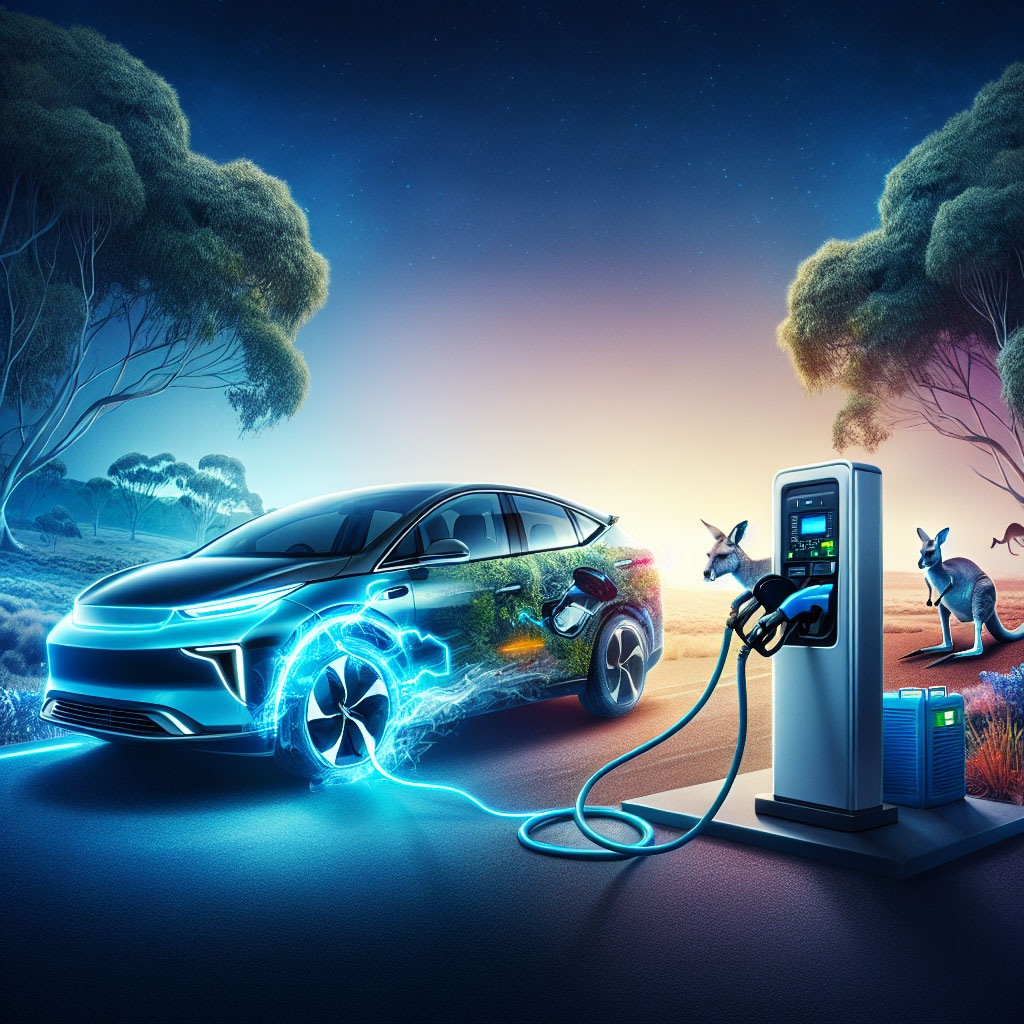
Close your eyes and picture this: You’re deep in the Australian bush, parked up at a secret spot overlooking the dunes. The sun is just starting to peek over the horizon. Usually, this is the part where you’d be fumbling with a gas stove, praying the wind doesn’t blow out your flame, or—worse—cranking up a noisy, vibrating diesel generator that ruins the serenity for everyone within a three-kilometre radius.
But not today. Today, you reach into your boot, plug a standard power board into your car, and press “Start” on your Nespresso machine. Within thirty seconds, the smell of fresh espresso is cutting through the salt air.
Welcome to the era of Vehicle-to-Load (V2L). At EV Evolution, we’ve seen plenty of tech come and go, but V2L is the one that turns “skeptics” into “believers.” It’s the feature that proves an EV isn’t just a way to get from A to B—it’s a massive, mobile power station that’s about to change how you spend your weekends.
🔌 What Exactly is V2L? (The Simple Version)
In the old world, a car battery’s only job was to start the engine and run the radio. In the EV world, your battery is essentially a 70kWh to 100kWh portable power bank.
V2L (Vehicle-to-Load) is the technology that lets you “bleed” that power back out of the car. Most V2L-capable cars in Australia provide a standard 240V AC outlet—exactly like the ones in your kitchen.
You plug an adapter into the car’s charging port (or use the internal socket under the back seat), and suddenly, you have between 2.2kW and 3.6kW of continuous power. To put that in perspective, a high-end portable “power station” (like a Jackery or EcoFlow) might cost you $3,000 for a 2kWh battery. Your car has thirty to fifty times that capacity sitting there for free.
☕ The “Fun” Factor: From Bush to Bliss
We’ve seen some incredible V2L setups across Australia in the last year, and the creativity is only growing as we head into 2026. If you’re a “glamper” at heart, V2L is your new best friend.
1. The Barista in the Wild
Forget instant coffee. With 3.6kW of power, you can run a full-sized espresso machine or a high-wattage kettle. There is something deeply satisfying about making a flat white in a location that doesn’t even have mobile reception.
2. The “Air Fryer” Campsite
Fire bans are a reality of the Australian summer. When you can’t light a campfire, you usually end up eating cold sandwiches. But with V2L, you can bring the air fryer or an induction cooktop. We’ve seen EV owners cooking roast chickens and hot chips at the beach—no gas, no flames, no worries.
3. The 48-Hour Fridge
One of the biggest headaches of camping is the ice slurry at the bottom of the Esky. Most EV owners now just plug a 45L portable fridge directly into the car. Because the fridge only draws about 50W when the compressor is running, you can keep your beers cold and your bacon fresh for a week without even making a dent in your driving range.
4. The “Bogan-Glam” Essentials
Let’s be honest: sometimes you just want a hairdryer after a swim, or you want to set up a projector and a screen to watch the footy under the stars. V2L handles it all. You can run fairy lights, charge your drones, and keep your laptops topped up—all while the car sits in total silence.
📊 The Math: Will I Get Stranded?
This is the “Elephant in the Room” question: “If I run my fridge and make ten coffees, will I have enough battery to get home?”
At EV Evolution, we like to deal in facts, not fear. Let’s look at the numbers for a typical weekend trip:
- Making 10 Coffees: Uses roughly 0.5kWh.
- Running a Fridge for 48 hours: Uses roughly 1.5kWh.
- Watching a 2-hour Movie on a Projector: Uses roughly 0.3kWh.
- Total Weekend Usage: ~2.3kWh.
If you have a Hyundai Ioniq 5 or a BYD Sealion 7 with an 80kWh battery, that entire weekend of “luxury” only used about 3% of your battery. You’ll lose more range from a strong headwind on the drive home than you will from powering your entire campsite.
Most cars also let you set a “Discharge Limit.” You can tell the car, “Stop giving out power if the battery hits 20%.” This ensures you always have enough juice to get to the next charger.
🇦🇺 2026: The Year V2L Becomes Standard
In 2023, V2L was a “party trick” for a few expensive models. In 2026, it’s becoming the benchmark for the Australian market.
The V2L Heavyweights:
- Hyundai & Kia: The E-GMP twins (Ioniq 5, Ioniq 6, EV6, EV9) remain the kings of V2L, offering a massive 3.6kW output. The upcoming Kia EV5 (arriving in force for 2026) is expected to bring this tech to a much more affordable price point.
- BYD: The entire Australian lineup—the Atto 3, Dolphin, Seal, and the new Sealion 7—comes with V2L as standard. While their output is usually slightly lower (around 2.2kW–3.3kW), it’s more than enough for 95% of camping gear.
- The Newcomers: Keep an eye on brands like Jaecoo (J5) and Geely (EX5). Their 2026 Australian specs almost all include V2L as a “must-have” feature to compete with the established players.
The Notable Absentees:
As of late 2025, the Tesla Model 3 and Model Y still don’t offer a “plug-and-play” V2L adapter for the Australian market. While they are world-leaders in software, if your primary goal is to run a coffee machine in the bush, you might find yourself looking toward the Korean or Chinese rivals.
🏁 Verdict: Your Car is the Ultimate Accessory
At EV Evolution, we believe the transition to electric isn’t just about saving the planet or saving money on petrol (though those are great perks). It’s about expanding what your car can do for you.
A petrol car is a heat-producing machine that sits idle 95% of the time. An EV with V2L is a tool. It’s a backup power source for your house during a blackout, a mobile office for the “work from anywhere” crowd, and the heart of the best campsite you’ve ever stayed at.
🤖 Join the Evolution: Find Your Power Match
Not every EV handles V2L the same way. Some have internal plugs, some need an external adapter, and some can only power low-wattage devices.
Don’t get stuck with a car that can’t boil a kettle.
At EV Evolution, our AI is updated with the latest 2026 spec sheets for every EV landing on Australian shores.
Ask the Chatbot today:
- “Which 2026 models include Vehicle-to-Load (V2L) as standard for under $60k?”
- “Can a BYD Sealion 7 run an 1800W air fryer?”
- “What is the difference between V2L and V2H (Vehicle-to-Home) in Australia right now?”
- “Does the 2026 Kia EV5 include the V2L adapter in the box?”
About EV Evolution
EV Evolution is the leading online platform dedicated to Australian electric vehicle owners and enthusiasts. We foster a vibrant community, delivering essential EV news and insights, and enhancing user engagement through our innovative, AI-powered chatbot for dynamic discussions. Our mission is to empower Australian electric vehicle owners and enthusiasts by fostering a vibrant, AI-driven online community that connects, informs, and advances the nation’s electric vehicle landscape.
